

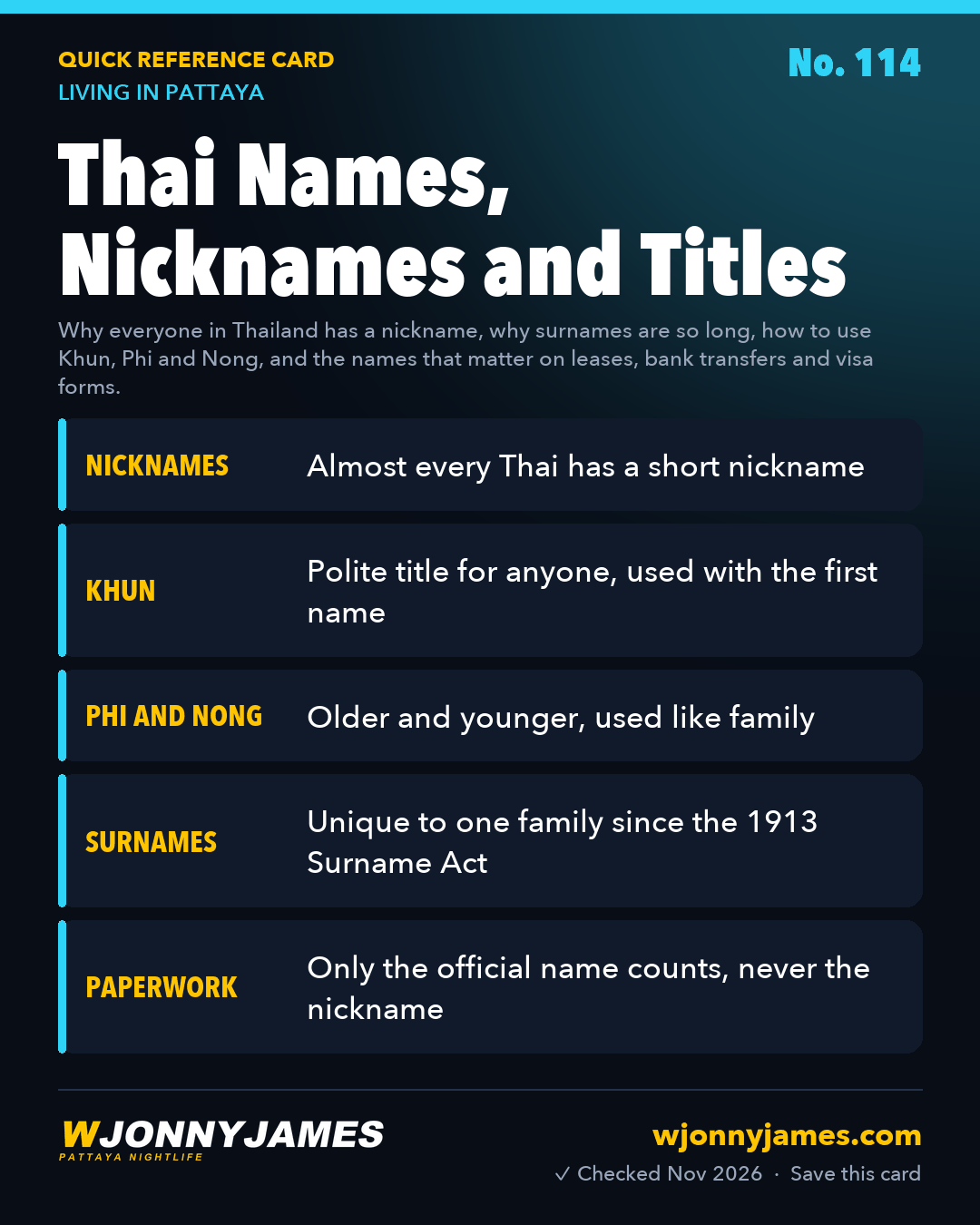
Quick answer: Thai people go by their first name, not their surname, and almost everyone also has a short nickname that friends, colleagues and even bosses use every day. To be polite, put Khun in front of someone’s first name or nickname: Khun Nok, Khun Lek. Use Phi for people older than you and Nong for younger people. Surnames are long because each one belongs to a single family by law, and they are rarely used in conversation. For anything official, such as a lease, a bank transfer or a visa form, the long official name is the only one that counts.
At a glance
| Term | Meaning | How to use it |
|---|---|---|
| Chue len | Nickname | What most people introduce themselves with: Nok, Lek, Ploy, Bank |
| Khun | Polite title for anyone | Before the first name or nickname, never the surname, never for yourself |
| Phi | Older brother or sister | For anyone a bit older than you, with or without a name |
| Nong | Younger brother or sister | For younger people; often used to call younger staff |
| Nai | Mr | On ID cards, forms and contracts |
| Nang / Nangsao | Mrs / Miss | On forms; married women can choose either |
| Khrap / kha | Polite endings | Men say khrap, women say kha |
Official names and nicknames
Official Thai first names are often long and carry a good meaning, and parents sometimes ask a monk or fortune teller to choose one. Day to day, almost nobody uses them. Nearly everyone has a nickname (chue len), usually given at birth, and it often has nothing to do with the official name. Nicknames can be Thai words, such as Nok (bird) or Ploy (gem), or English words and even brand names, such as Bank, Beer, Gift and Mint. Some families once gave babies deliberately unflattering nicknames to keep jealous spirits away.
Friends, colleagues, landlords and shop staff will usually introduce themselves by nickname. Many people you deal with for years may never tell you their official name, and that is normal, not rude.
Name changes are also common. Thai law allows people to change their first name for any reason, and some do it after a run of bad luck or on advice from an astrologer. A friend may announce a new name one day.
Why Thai surnames are so long
Surnames only became compulsory under the Surname Act of 1913, during the reign of King Vajiravudh (Rama VI). The rule was that each surname must belong to one family only, and the law still says a new surname cannot repeat one already registered. With millions of families needing different names, many became long and complicated. Today a new surname can be up to 10 Thai letters, but spelled in English it often looks much longer.
Because surnames are unique, two people with the same surname are usually related.
Khun
Khun is the safe, polite choice with anyone: strangers, officials, older people, your landlord. It works for men and women and goes before the first name or nickname. Saying Khun plus a surname, the Western “Mr Smith” way, sounds wrong in Thai. Never use Khun about yourself.
That is why Thai bank staff, receptionists and hospital clerks will call you “Khun John” or “Mr John”, using your first name even in formal settings.
Phi and Nong
- Phi means older brother or sister and is used for anyone older than you, even only by a year or two.
- Nong means younger brother or sister and is used for anyone younger.
- Both work for men and women, on their own or before a name: Phi Ton, Nong Fern.
- In restaurants, many people call a younger server “nong” to get their attention. Sources differ on whether visitors should do this with strangers. If you’re unsure, Khun is never wrong.
Thais also call older strangers by family words: Lung (uncle) for an older man, Pa (aunt) for an older woman. You will hear these at markets and from motorbike taxi riders.
Job titles work too: Khru or Ajarn for a teacher, and Mo for a doctor.
Titles on paperwork: Nai, Nang and Nangsao
Official documents use Nai (Mr) for men, Nang (Mrs) for married women and Nangsao (Miss) for unmarried women. Since the Form of Address for Women Act 2008, married or divorced women can choose Nang or Nangsao. A married woman can also choose whether to keep her own surname or take her spouse’s. If you’re marrying in Thailand, see marriage visa and Thai wedding customs.
Why the official name matters to you
- Leases and receipts: your landlord’s nickname means nothing on a contract. Check that the name on the lease matches their ID or the owner’s title deed. See renting a condo.
- Bank transfers: when you pay by PromptPay or bank app, the screen shows the receiver’s official name before you confirm. If it doesn’t match the person or business you expected, stop. See QR payments.
- English spellings vary: the same Thai name can be spelled several ways in English, and registry offices haven’t always been consistent. Copy names exactly from the passport or ID card for visa and immigration forms.
Polite words
Men end sentences with “khrap” and women with “kha” to sound polite: “khop khun khrap” (thank you). A smile and a polite ending go a long way. See useful Thai phrases and Thai etiquette.
Common questions
Is it rude to ask someone’s nickname? No. It’s normal, and people often offer it straight away. Asking “chue len arai?” means “what’s your nickname?”
Should I call my Thai friend by surname? No. Surnames are for paperwork. Use their nickname, or Khun plus their first name if you don’t know them well.
Can I call a waiter Nong? Many Thais do with younger staff, and it’s friendly. Use Phi for someone older. If in doubt, a polite “khaw thot khrap/kha” (excuse me) works with anyone.
Why do Thais call me Mr plus my first name? Thai titles go with the first name, so “Mr John” is the Thai way of saying “Mr Smith”. It is polite, not over familiar.
Sources
Checked 13 November 2026: Library of Congress, Understanding Thai names: law and culture (July 2025, on the Surname Act, the Person’s Name Act and name changes); Cultural Atlas, Thai naming; Wikipedia, Thai name (titles and the Form of Address for Women Act 2008); Thai Holiday Guide, forms of address. Sources differ on whether visitors should use Phi and Nong with strangers.
Related guides

Related pages



Ride along with Jonny
Every guide page comes from the nightly rides through Pattaya. Watch them, ask questions in the community, or help keep the camera rolling.
Watch the rides Join the Telegram Leave a tip Support the rides
 ไทย
 中文
 Русский
 한국어
 Deutsch
 Français