

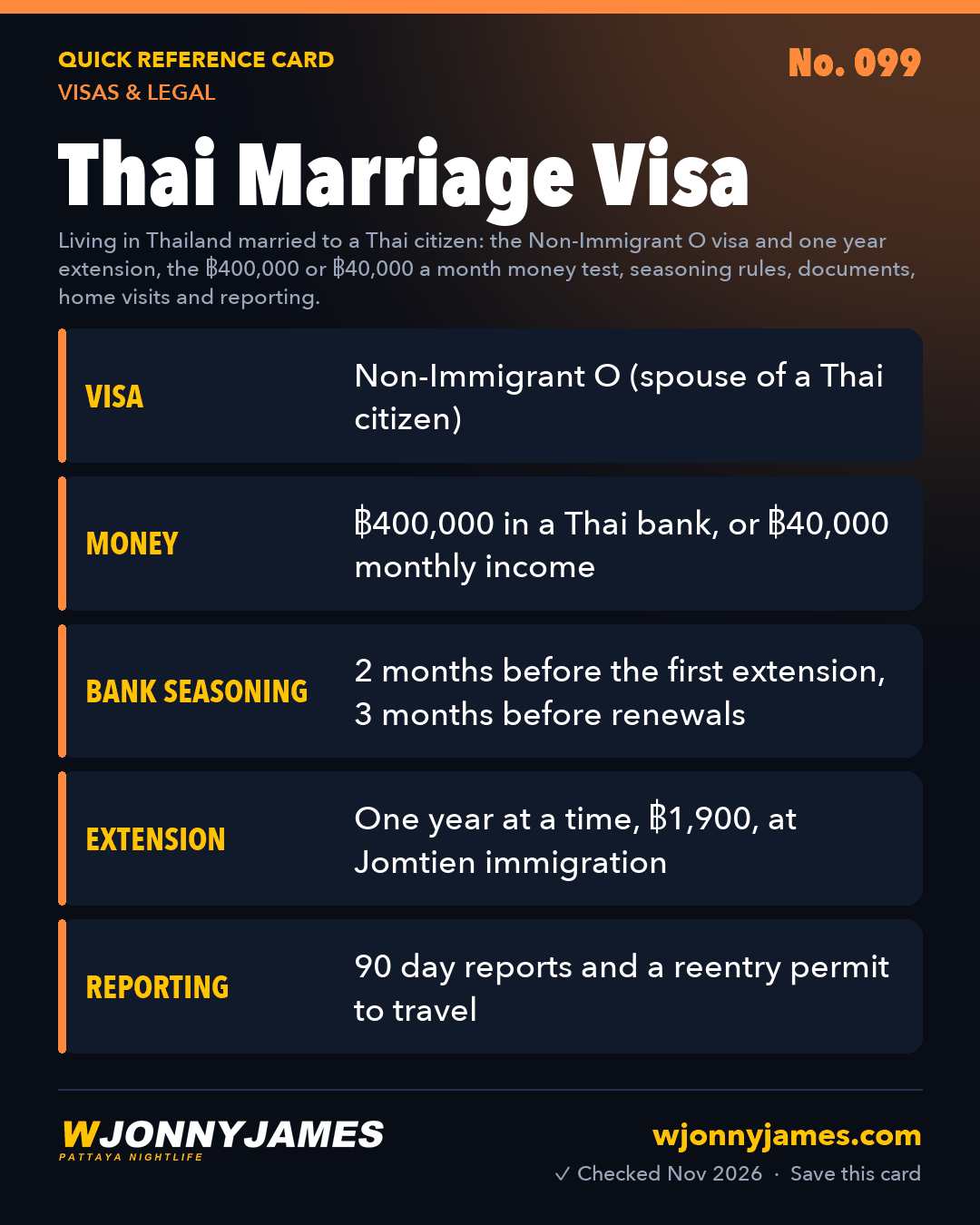
Quick answer: If you are legally married to a Thai citizen, you can live in Thailand on a marriage based Non-Immigrant O visa and extend it one year at a time at the Jomtien immigration office. The marriage must be registered under Thai law. The money test is either ฿400,000 in a Thai bank account in your own name or an income of at least ฿40,000 a month. 2026 guides say the money should be in the account for two months before your first extension and three months before each renewal. The extension fee is ฿1,900, the file usually sits “under consideration” for about 30 days, and officers may visit your home. Same sex spouses qualify too. Offices differ in the details, so check with Jomtien first.
At a glance
| What | Detail |
|---|---|
| Who | Foreigners legally married to a Thai citizen, same sex couples included |
| Visa | Non-Immigrant O, 90 days, then a one year extension inside Thailand |
| Money | ฿400,000 in a Thai bank in your name, or ฿40,000 a month income |
| Seasoning | 2 months before the first extension; 3 months before renewals |
| Fee | ฿1,900 per yearly extension (form TM.7) |
| Processing | About 30 days “under consideration”, then a second visit for the stamp |
| Home visit | Possible, before or after the extension is granted |
| Ongoing | 90 day reports, TM.30, a reentry permit for trips abroad |
| Work | Not included; a work permit is a separate application |
Who it is for
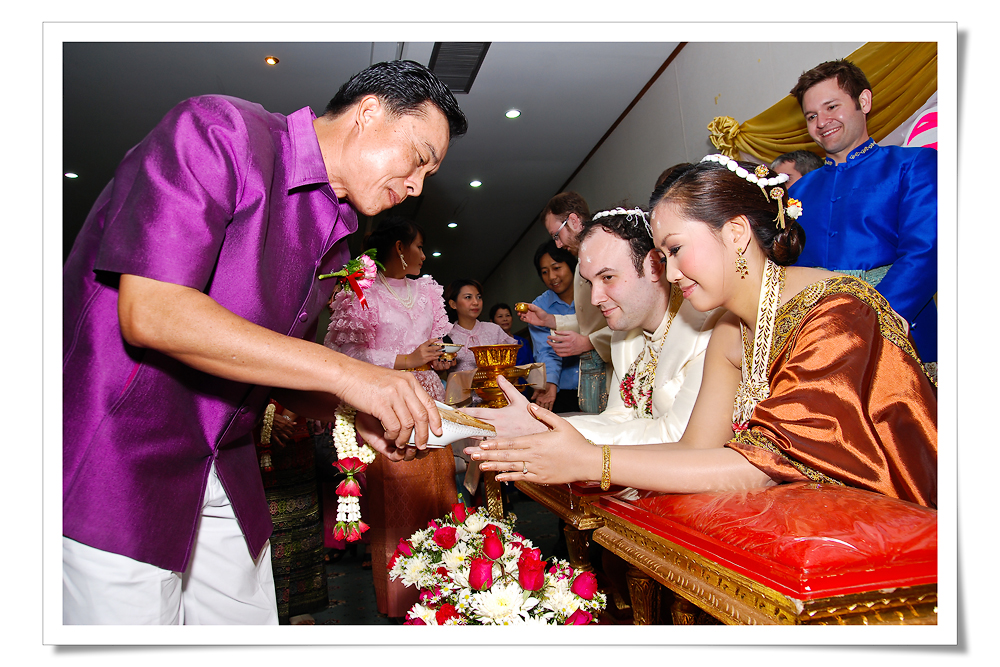
- You need a legal marriage, not a ceremony alone. A marriage in Thailand is registered at a district office (amphoe), and you receive the marriage certificate and its registration record (Kor Ror 2 and Kor Ror 3). A marriage registered abroad is recorded in Thailand as a family status registration (Kor Ror 22).
- Since the Marriage Equality Act took effect on 23 January 2025, a same sex spouse of a Thai citizen can apply on the same basis, both for the 90 day visa abroad and the one year stay inside Thailand.
- A partner, fiancé or fiancée doesn’t qualify. A Thai wedding party without registration doesn’t either. See Thai wedding customs and dating in Thailand.
Getting the first Non-O
There are two usual ways in.
- From abroad: apply for a 90 day Non-Immigrant O through the Thai e-visa system to the embassy for the country where you live. Embassies generally only accept residents of their area, and they set their own document lists and fees.
- Inside Thailand: some offices let you change from a visa exemption or tourist visa to a 90 day Non-O. A 2026 agency guide says you need at least 21 days left on your stay and the ฿400,000 already in a Thai bank, and that it usually takes three visits. Ask Jomtien first, because practice varies by office.
- Then, near the end of the 90 days, apply for the one year extension.
The money requirement
- Bank route: ฿400,000 in a Thai savings account in your own name. The Thaiger’s August 2026 guide says the money is held for two full months before the first application and three months before each renewal. Some guides say the full amount should stay in the account all year, so don’t plan to spend it. See Thai bank account.
- Income route: at least ฿40,000 a month. Income from abroad is usually shown with an income letter from your embassy, but not every embassy issues one (an October 2026 guide names the US). Income from a Thai job is shown with a work permit and tax filings.
- Your spouse’s money doesn’t count. Immigration tests the foreign applicant’s funds.
- Combining the two: sources disagree on whether a smaller deposit plus some income is accepted. Plan to meet one test in full.
- Some guides say offices may not apply the money test when the foreign spouse is the wife of a Thai man. Confirm with the office rather than relying on it.
The retirement route has different numbers (฿800,000 or ฿65,000 a month) and its own timing rules. See retirement visa.
Typical documents
- Passport, the TM.7 form and a 4 x 6 cm photo, with signed copies of the passport pages.
- Marriage certificate and Kor Ror 2 (or Kor Ror 22), with recent copies of the registration record; one guide says issued within the last six months.
- Your spouse’s Thai ID card and house registration (tabien baan).
- Bank letter dated the day you apply, plus the bank book or statements, or your income evidence.
- Photos of you both at home, inside and outside with the house number visible, and a map to the house.
- Your TM.30 receipt and proof of address, such as a lease.
Offices outside Bangkok often want two signed copies of everything. See Thai paperwork tips.
The yearly extension
- File at Jomtien before your current permission ends, ideally in the last 30 days. Go early; see Jomtien immigration office for hours.
- Pay ฿1,900. You usually get an “under consideration” stamp of about 30 days, sometimes up to 45, then return for the one year stamp.
- An officer may visit your home, before or after approval. Keep the photos and address details consistent with what you filed.
- The extension depends on the marriage. If the marriage ends, you need another basis to stay, so speak to immigration straight away.

Living on a marriage extension
- Report your address every 90 days. See 90 day reports.
- Get a reentry permit before every trip abroad, or the extension is cancelled when you leave.
- The visa doesn’t let you work, but spouses of Thai citizens can apply for a work permit with an employer. See working legally.
- Staying 180 days or more in a year can make you a Thai tax resident. See Thai tax basics.
Marriage or another visa?
| Visa | Money | Good to know |
|---|---|---|
| Marriage (Non-O) | ฿400,000 or ฿40,000 a month | Needs a registered marriage; home visits possible |
| Retirement | ฿800,000 or ฿65,000 a month | Age 50 and over; no marriage needed |
| DTV | ฿500,000 in savings | Five years; leave Thailand about once a year |
| Thailand Privilege | Membership fee up front | No yearly money test |
See all the options on visa options.
Common questions
How much money do I need for a Thai marriage visa? ฿400,000 in a Thai bank in your name, or ฿40,000 a month income. Sources disagree on mixing the two.
How long must the ฿400,000 be in the bank? Usually two months before your first extension and three months before each renewal. Some guides say it should stay there all year.
Can same sex couples get a Thai marriage visa? Yes, since the Marriage Equality Act took effect on 23 January 2025, if the marriage is legally registered.
Can I work on a marriage visa? Not without a work permit. With an employer, a spouse of a Thai citizen can apply for one.
Sources
Checked 13 November 2026: The Thaiger, marriage visa expiry and extensions (August 2026); Issa Compass, Thai marriage visa requirements 2026 (October 2026), a visa agency, cited for facts only; Expatica, Non-O visa Thailand (September 2026); Fragomen, visa pathways for same sex spouses (March 2025). These are not official immigration pages, and they differ on combining income and savings and on how long the money stays. Rules change and offices differ: confirm with Jomtien immigration or a reputable agent before you apply. General information, not legal advice.
Related pages
Ride along with Jonny
Every guide page comes from the nightly rides through Pattaya. Watch them, ask questions in the community, or help keep the camera rolling.
Watch the rides Join the Telegram Leave a tip Support the rides

 ไทย
 中文
 Русский
 한국어
 Deutsch
 Français