

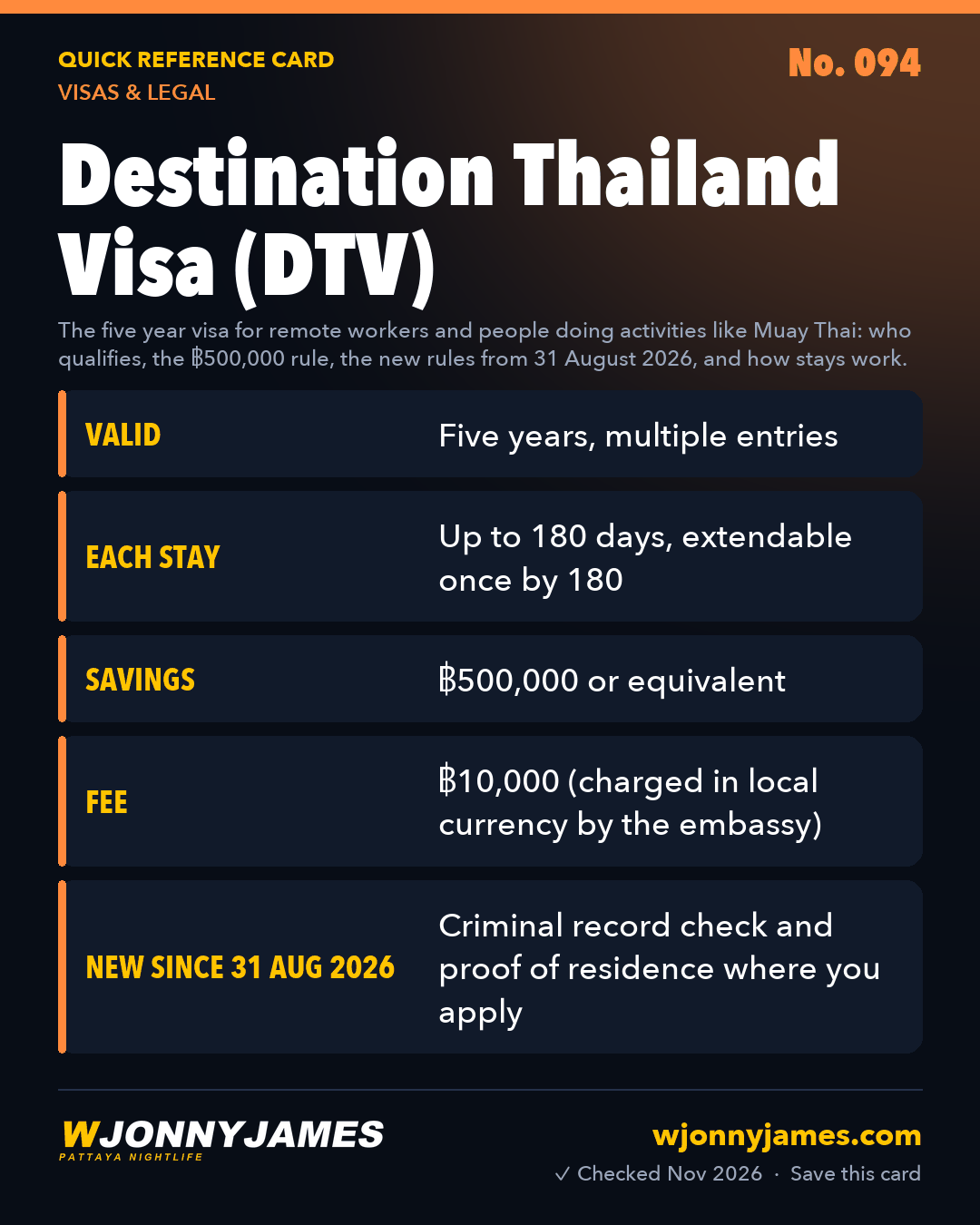
Quick answer: The Destination Thailand Visa (DTV) is a five year, multiple entry visa for remote workers who earn from outside Thailand and for people taking part in Thai “soft power” activities such as living-in-pattaya/gyms-fitness/">Muay Thai training, cooking courses or medical treatment. Each entry lets you stay up to 180 days, and each stay can be extended once by up to 180 more. You need at least ฿500,000 (or the equivalent) in savings, usually held for three months, and the fee is ฿10,000. Since 31 August 2026, applicants also need a criminal record certificate and proof of permanent residence in the country where they apply, and you apply through the Thai e-visa system from outside Thailand.
At a glance
| What | Detail |
|---|---|
| Validity | 5 years, multiple entries |
| Each stay | Up to 180 days per entry |
| Extension | Once per entry, up to 180 days, at an immigration office |
| Money | At least ฿500,000 or equivalent, bank statements usually covering 3 months |
| Fee | ฿10,000 (paid in local currency at the embassy rate) |
| Apply | Thai e-visa system, from outside Thailand |
| New from 31 Aug 2026 | Criminal record certificate; proof of permanent residence where you apply |
| Family | Spouse and children under 20 can apply as dependants |
| Work | Not for Thai employers or Thai clients |
Who qualifies
- Remote workers (“workcation”): people employed by, or freelancing for, companies and clients outside Thailand, including digital nomads and freelancers. You show an employment contract, an employer letter or a portfolio showing foreign clients.
- Soft power activities: people enrolled with a Thai provider for activities like Muay Thai, Thai cooking courses or medical treatment, with an invitation or enrolment letter from the provider.
- Thai language courses are reported to be no longer accepted as a qualifying DTV activity; if you want to study Thai, an education visa is usually the route. Ask the embassy before you rely on any course.
- Dependants: a spouse and children under 20, with documents proving the relationship.
What you need to apply
- A passport with at least six months left.
- Proof of at least ฿500,000 or the equivalent: bank statements, usually covering three months or more, or a sponsor letter. Some embassies ask for a longer history.
- Proof of your remote work or your activity enrolment.
- Since 31 August 2026: a criminal record clearance certificate.
- Since 31 August 2026: proof of permanent residence in the country where you apply, such as a national ID or permanent residence card. Embassies differ on what they accept from people living abroad on temporary permits.
- The ฿10,000 fee, charged in the embassy’s local currency.

How to apply, step by step
1. Pick your track: remote work (“workcation”) or a soft power activity. Your documents follow from that choice. 2. Get your papers in order before you start: three months or more of bank statements showing ฿500,000 or more, proof of work or enrolment, the criminal record certificate, and proof of residence where you apply. 3. Apply on the official e-visa site, thaievisa.go.th, choosing the embassy or consulate for your nationality or permanent residence. 4. Pay the ฿10,000 fee in that country’s currency. The Thaiger notes the fee is not refunded if you are refused, so get your file right first. 5. Wait for the decision by email. Processing time varies by embassy. 6. Enter Thailand and check your stamp says 180 days before you leave the counter.
Why applications get refused
Siam Legal, a Bangkok law firm, lists these as common reasons (September 2026):
- Proof of funds in crypto, investments or a business account instead of personal cash savings.
- Applying from inside Thailand or from a country where you aren’t a national or permanent resident.
- Thin evidence of remote work: no contract, invoices or portfolio for freelancers.
- A soft power provider the embassy doesn’t accept, or documents formatted differently from what that embassy asks for.
The 31 August 2026 changes
Thailand’s Department of Consular Affairs added two requirements for applications submitted on or after 31 August 2026 (Thailand time). The date that matters is when you submit and pay, not when the visa is issued. The practical effect is that you can no longer pick an easy embassy in a neighbouring country: you apply where you hold nationality or permanent residence. Embassies apply this differently. Some accept temporary residence cards, some don’t, so read the page of the exact embassy you will use before you pay.

How the stays work
- Each entry gives you up to 180 days.
- Each stay can be extended once, by up to 180 days, at an immigration office. In Pattaya that is Jomtien immigration office. The fee is ฿1,900, the standard extension fee (The Thaiger and Siam Legal). Some older articles say ฿10,000 for the extension; that is the visa fee, not the extension fee.
- For the extension, Siam Legal says to bring an updated bank statement that still shows ฿500,000 or more, and to apply before your 180 days run out. It is the officer’s decision, not automatic.
- After that you leave Thailand and come back to start a new 180 days. Many DTV holders time this with a holiday or a short trip. See border runs.
- Siam Legal says you don’t need a reentry permit on the DTV, because it is a multiple entry visa and each entry gives a fresh 180 days. Leaving during an extension ends that extension, though, so time trips with that in mind.
- The DTV itself expires after five years. Check how a stay near the end would work with the embassy before you plan around it.
- You report your address every 90 days of continuous stay, and your landlord still files TM30. See 90 day reports and TM30 explained.
A year on a DTV, as an example
Say you land on 1 March and stay as long as one entry allows. Dates are approximate; your stamps and receipts are what count.
| When | What | Where |
|---|---|---|
| 1 March | Enter, 180 day stamp | Airport or border |
| Within 24 hours | Landlord or hotel files TM30 | Landlord’s job |
| About 29 May | 1st 90 day report | In person or agent |
| Late August | Extension (฿1,900), and the 2nd 90 day report | Jomtien immigration |
| About 25 November | 3rd 90 day report | Online, in person or agent |
| About 23 February | Extended stay ends (about 360 days): leave Thailand, then come back for a new 180 days | Anywhere abroad |
DTV or another visa?
| Visa | Best for | Main catch |
|---|---|---|
| DTV | Remote workers and long stayers under 50 | Leave Thailand at least once a year; can’t work for Thai clients |
| Retirement | Age 50 and over | ฿800,000 in a Thai bank or a monthly income |
| Education | People who want to learn Thai | Real class attendance is checked |
| Thailand Privilege | People who want no paperwork rules on income | ฿650,000 to ฿5 million up front |
| Work visa | Working for a Thai company | Needs an employer and a work permit |
See all the options on visa options.

Living on a DTV
- Banking can be harder. Siam Legal reports that major Thai banks have tightened up and often refuse new accounts for DTV holders, so keep a foreign card that works here and read Thai bank account before you count on one.
- Remote work for clients outside Thailand is the idea. Working for Thai companies or Thai clients needs a work permit. See working legally.
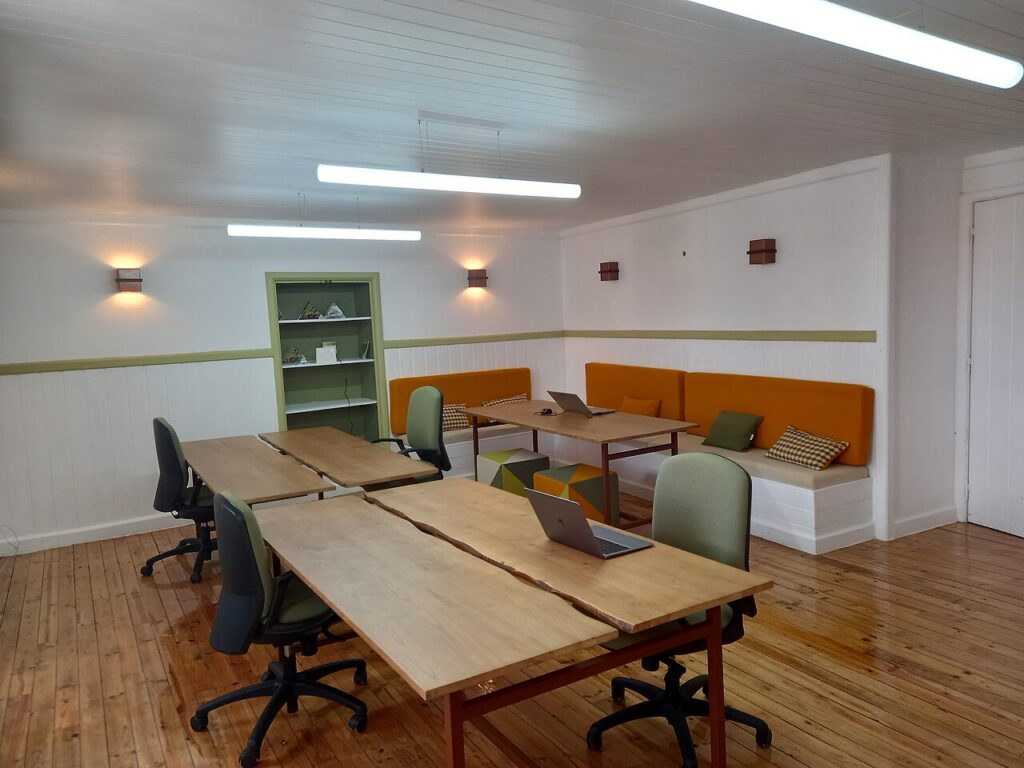
- Coworking spaces and good internet help. See coworking spaces, home internet and digital nomads.
- Staying 180 days or more in a tax year can make you a Thai tax resident, and foreign income brought into Thailand may then be taxable. See Thai tax basics and get advice for your situation.
- Health insurance isn’t a DTV requirement, but hospital bills here are real. See health insurance.
Pro tip: I live on a Thailand Privilege visa and, as an entrepreneur, I wish I’d waited for the DTV instead. My number one advice before choosing any long visa: come on a tourist stay, extend it, and use that time to ask locals on the ground. Things in Pattaya are a bit different than online.
Common questions
Can I apply for the DTV inside Thailand? No. You apply through the Thai e-visa system to an embassy or consulate outside Thailand, and since 31 August 2026 it must be the one for your nationality or permanent residence.
How long can I stay on a DTV? Up to 180 days per entry, plus one extension of up to 180 days, so about a year before you need to leave and reenter. The visa itself lasts five years.
Do I need ฿500,000 in a Thai bank? No, it can be in a bank abroad. Embassies usually want statements covering three months or more.
Is Thai language school still accepted for the DTV? Reports from 2026 say language courses no longer qualify as a DTV activity. An education visa is the usual route for studying Thai.
How much is the DTV extension? ฿1,900 at an immigration office, for up to 180 more days, once per entry. The ฿10,000 figure you may see is the visa fee.
Do I need a reentry permit on a DTV? Siam Legal says no: it is multiple entry, and each entry gives a new 180 days. You do lose an extension if you leave during it.
Can my partner come on my DTV? A legal spouse and unmarried children under 20 can apply as dependants. The Thaiger says each pays the full ฿10,000 fee.
Can I work in Pattaya on a DTV? Only remotely for employers and clients outside Thailand. Working for Thai businesses needs a work permit.
Sources
Checked 15 November 2026: The Thaiger, DTV requirements and cost (extension fee, dependants, refunds); Siam Legal, DTV visa Thailand (updated September 2026) (extension, refusals, banking, reentry). Checked 13 November 2026: Lex Bangkok, DTV rules from 31 August 2026 (citing the Royal Thai Embassy notices and the Department of Consular Affairs announcement of 28 August 2026); Thailand e-Visa official site. Rules differ by embassy and change often. This is general information, not legal advice; check the embassy that will receive your application.
Related pages
Ride along with Jonny
Every guide page comes from the nightly rides through Pattaya. Watch them, ask questions in the community, or help keep the camera rolling.
Watch the rides Join the Telegram Leave a tip Support the rides

 ไทย
 中文
 Русский
 한국어
 Deutsch
 Français