

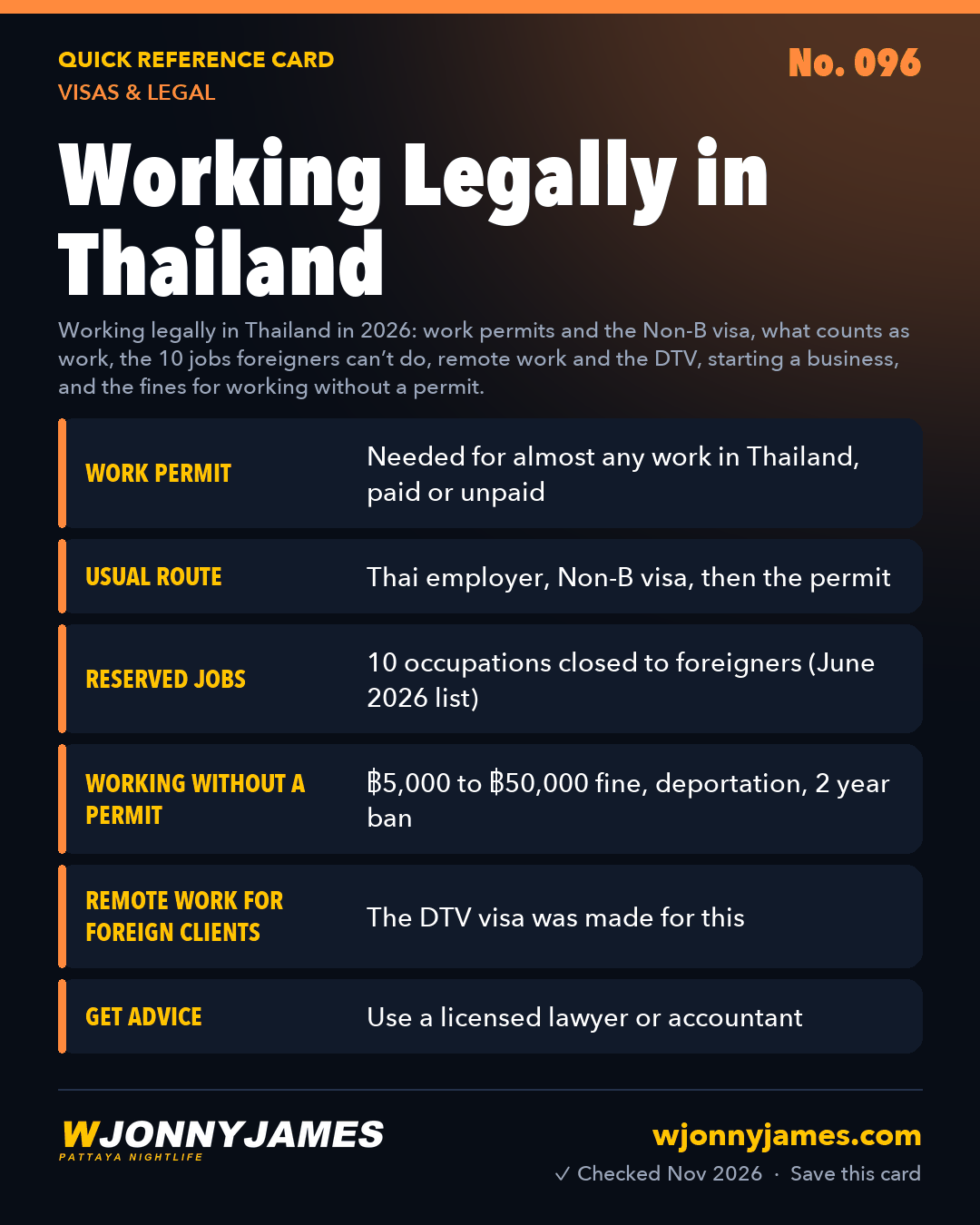
Quick answer: Almost any work in Thailand needs a work permit, and the permit is tied to a specific employer and job. The usual route is a Thai company that hires you, a Non-Immigrant B visa, then the permit, filed online through the e-WorkPermit system. Some jobs are closed to foreigners even with a permit, including street vending, Thai massage, hairdressing, driving and tour guiding. Working without a permit, or outside what it allows, can mean a fine of ฿5,000 to ฿50,000, deportation and a two year ban on getting a permit. If you work online for employers or clients outside Thailand, the DTV visa was designed for you. Rules change, so treat this as an overview and get professional advice before you start.
At a glance
| What | Detail (November 2026) |
|---|---|
| Who needs a permit | Almost anyone working in Thailand, paid or unpaid |
| Usual visa | Non-Immigrant B, linked to a Thai employer |
| Employer rules | Usually ฿2 million paid up capital and 4 Thai staff per foreign worker |
| Exceptions | BOI promoted companies and some offices can have different rules |
| Reserved jobs | 10 occupations, including Thai massage, driving and tour guiding |
| Penalty, worker | ฿5,000 to ฿50,000, deportation, 2 year ban on a work permit |
| Penalty, employer | ฿10,000 to ฿100,000 per worker; more for repeat offences |
| Remote work for foreign clients | DTV visa |
What counts as work
Thai law looks at what you actually do, not where you are paid or whether you have a contract. A July 2026 ASEAN Briefing guide puts it simply: whether you need a permit depends on the activities you perform. That catches people out in Pattaya:
- Helping out in a friend’s bar, restaurant or guesthouse, even unpaid, can count as work.
- Selling things, teaching, guiding or driving for money all need a permit, and some can’t be done by foreigners at all.
- Volunteering can count too. Check with the organisation that it handles permits before you sign up.
Getting a work permit
- An employer in Thailand sponsors you. You normally get a Non-Immigrant B visa first, then the employer applies for the permit.
- Applications, renewals and cancellations go through the Department of Employment’s e-WorkPermit platform.
- Under the standard rules, the employer needs about ฿2 million in paid up capital and four Thai employees for each foreign work permit. Companies promoted by the Board of Investment (BOI) and some regional or representative offices can have these rules changed or waived.
- The permit covers one employer and one job description. Changing jobs means changing the permit.
- Spouses of Thai citizens on a marriage visa can apply for a permit with an employer too.
Jobs foreigners can’t do
In June 2026 the Ministry of Labour publicised a list of 10 occupations that foreigners may not do, even with a work permit and even as a side job:
- Street vending: hawker stalls, pavement stalls, pushcarts and lottery tickets.
- Brokerage and agency work, except brokerage in international trade.
- Hairdressing, beauty and nail work.
- Thai massage, traditional and spa.
- Driving vehicles such as taxis, vans, three wheelers and buses (forklifts in factories are an exception).
- Tour guiding and organising tours.
- Legal services, apart from some arbitration work.
- Hand woven cloth work.
- Traditional crafts such as wood carving, silverware, goldware and Thai doll making.
- Security guard work.
For anyone in Pattaya, that rules out giving rides for money, running a massage shop yourself or guiding tourists.
Remote work and the DTV
- Working online for an employer or clients outside Thailand was a grey area for years. The Destination Thailand Visa (DTV) was created for remote workers and digital nomads, with stays of up to 180 days per entry.
- The DTV doesn’t cover work for Thai companies or Thai clients. That needs a work permit.
- Staying 180 days or more in a year can make you a Thai tax resident, and foreign income brought into Thailand may then be taxed. See Thai tax basics.
- For places to work, see coworking spaces and digital nomads.
Starting a business
- In many sectors, foreigners can’t own the majority of a Thai company. Common routes are a Thai company with Thai shareholders, BOI promotion, or treaty options for some nationalities.
- Using Thai nominee shareholders to hide foreign control is illegal. Arrangements that look fine on paper can fall apart, and you can lose the business.
- Owning a company doesn’t let you work in it. You still need a visa and a work permit, and the company has to meet the capital and Thai staff rules.
- Use a licensed lawyer and accountant. Be wary of anyone offering shortcuts.
Pro tip: he lives on a Thailand Privilege visa and, as an entrepreneur, wishes he’d waited for the DTV or opened a business with a work visa. For people who aren’t entrepreneurs and want to learn some Thai, he thinks the education visa is fantastic. See visa options.
Enforcement in 2026
In May 2026 the Labour Minister ordered nationwide checks of foreign workers and work permits after a raid on a childcare business on Koh Phangan led to nine arrests. The Department of Employment is coordinating inspections through provincial offices, and the public can report suspected illegal work. Expect checks in tourist areas, Pattaya included.
Risks of working illegally
- Workers: a fine of ฿5,000 to ฿50,000, deportation, and a two year ban on applying for a work permit.
- Employers: ฿10,000 to ฿100,000 per foreign worker. Repeat offences can bring up to a year in prison or fines of ฿50,000 to ฿200,000 per worker, and a three year ban on hiring foreigners.
- Deportation can also mean a ban on returning to Thailand.
- Get advice from a qualified lawyer before you start any work. See laws visitors break.
Common questions
Can I work in Thailand on a tourist visa or visa exemption? No. Tourist stays don’t allow work. You need the right visa and a work permit.
Can I work remotely from Pattaya? For employers or clients outside Thailand, the DTV visa was made for this. Work for Thai companies or clients needs a work permit.
What jobs can’t foreigners do in Thailand? Ten occupations, including street vending, Thai massage, hairdressing, driving, tour guiding, legal services and security work, even with a permit.
What is the fine for working without a permit in Thailand? ฿5,000 to ฿50,000 for the worker, plus deportation and a two year ban on getting a permit. Employers face ฿10,000 to ฿100,000 per worker.
Does volunteering need a work permit? It can. Unpaid work can still count, so check before you start.
Sources
Checked 13 November 2026: The Nation, Labour Minister orders foreign worker permit checks (3 May 2026); Asia News Network (from The Nation), 10 jobs foreigners cannot do (15 June 2026); ASEAN Briefing, work permit rules (15 July 2026). Rules and penalties change; check with the Department of Employment or a licensed lawyer. General information, not legal advice.
Related guides

Related pages


Ride along with Jonny
Every guide page comes from the nightly rides through Pattaya. Watch them, ask questions in the community, or help keep the camera rolling.
Watch the rides Join the Telegram Leave a tip Support the rides

 ไทย
 中文
 Русский
 한국어
 Deutsch
 Français