

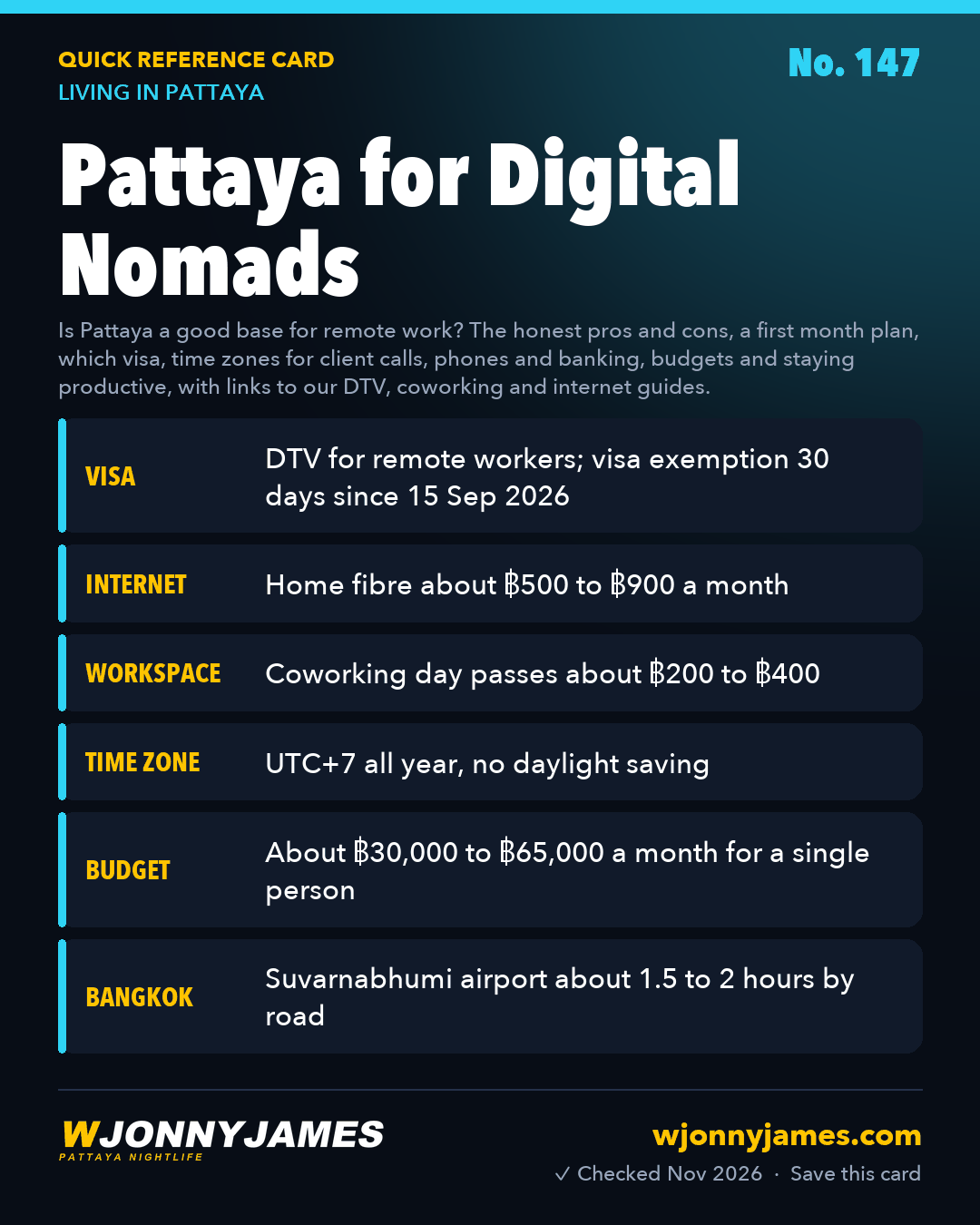
Quick answer: Pattaya is a good, affordable base for remote work if your clients or employer are outside Thailand. Home fibre costs about ฿500 to ฿900 a month, coworking day passes about ฿200 to ฿400, condos are good value, and Bangkok’s main airport is about 1.5 to 2 hours by road. The usual visa is the Destination Thailand Visa (DTV), which you apply for from abroad. Since 15 September 2026, the visa exemption gives most visitors 30 days, so a trial month before committing works well. The trade offs: the remote work community is smaller than in Bangkok, the nightlife can eat your time and money, and Thailand’s UTC+7 time zone means late calls for clients in the Americas.
At a glance
| What | Detail (about, November 2026) |
|---|---|
| Visa for remote work | DTV: up to 180 days per entry, extendable once |
| Trial stay | Visa exemption: 30 days, extend once by up to 30 for ฿1,900 |
| Home internet | Fibre, about ฿500 to ฿900 a month |
| Coworking | Day pass about ฿200 to ฿400; month about ฿2,500 to ฿4,000 |
| Living costs, single | About ฿30,000 to ฿65,000 a month including rent |
| Time zone | UTC+7, no daylight saving |
| Thai SIM | Registered in person with a face check |
Pros and cons
| Good for remote work | Watch out for |
|---|---|
| Cheap, fast fibre in most condos | Smaller remote work community than Bangkok |
| Good value condos, short and long leases | Nightlife that makes late starts easy |
| Beach, gyms and sport for after work | High season traffic and crowds |
| Suvarnabhumi airport 1.5 to 2 hours by road | Rainy season storms and short power cuts |
| Long stay visa built for remote workers | Late calls if your clients are in the Americas |
Your first month
- Before you fly: fill in the TDAC arrival card and book a hotel or short let for the first week or two. See Bangkok to Pattaya.
- Week one: get a Thai SIM in person with your passport; since 16 May 2026 shops register new SIMs with a face check. Keep your home number for bank codes. See SIM cards and eSIMs.
- Weeks one and two: try a few areas, a coworking day pass and some cafés. Run a speed test anywhere you might work.
- Weeks two to four: view condos at night, ask for a speed test, and check what internet is included. See renting a condo and noise and sleep.
- Before day 30: extend your stay at Jomtien immigration if you need more time (once, up to 30 days, ฿1,900), or leave. Overstaying costs ฿500 a day. See visa extension.
- Staying longer: apply for the DTV from your home country. Since 31 August 2026 that means the embassy where you hold nationality or permanent residence.
Visa in brief
The DTV is the visa made for remote workers: five years, multiple entries, up to 180 days a stay, extendable once, with ฿500,000 in savings. Working for Thai companies or Thai clients needs a work permit whatever your visa. The full rules are on DTV visa, working legally and visa options.
Where to work
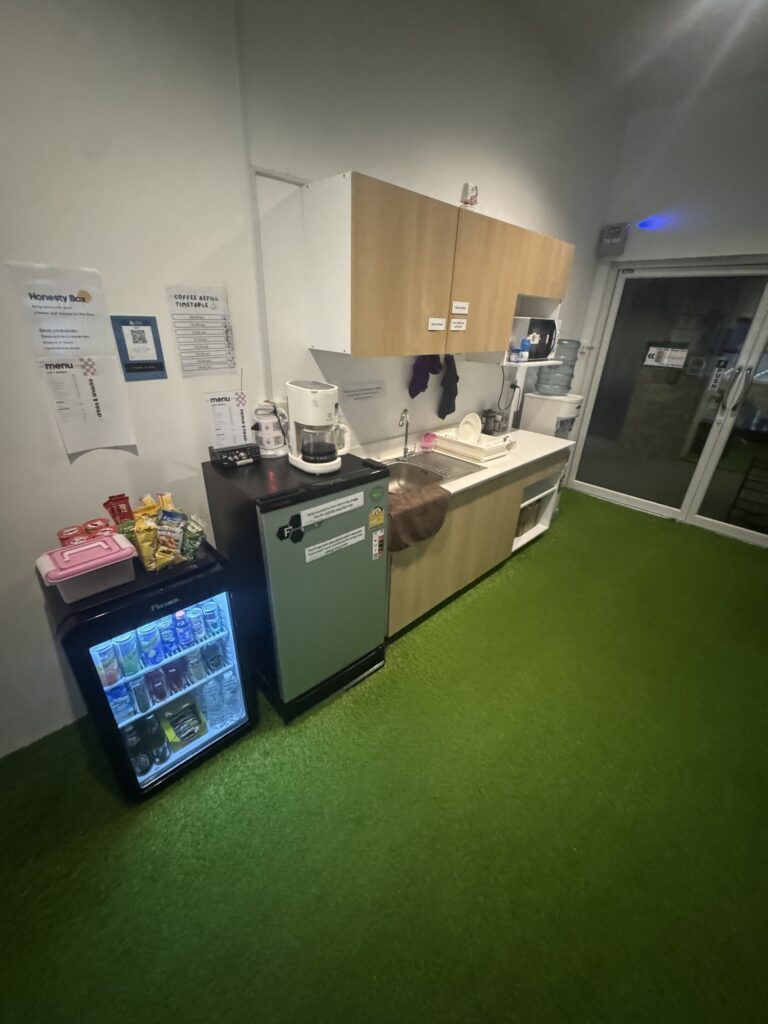
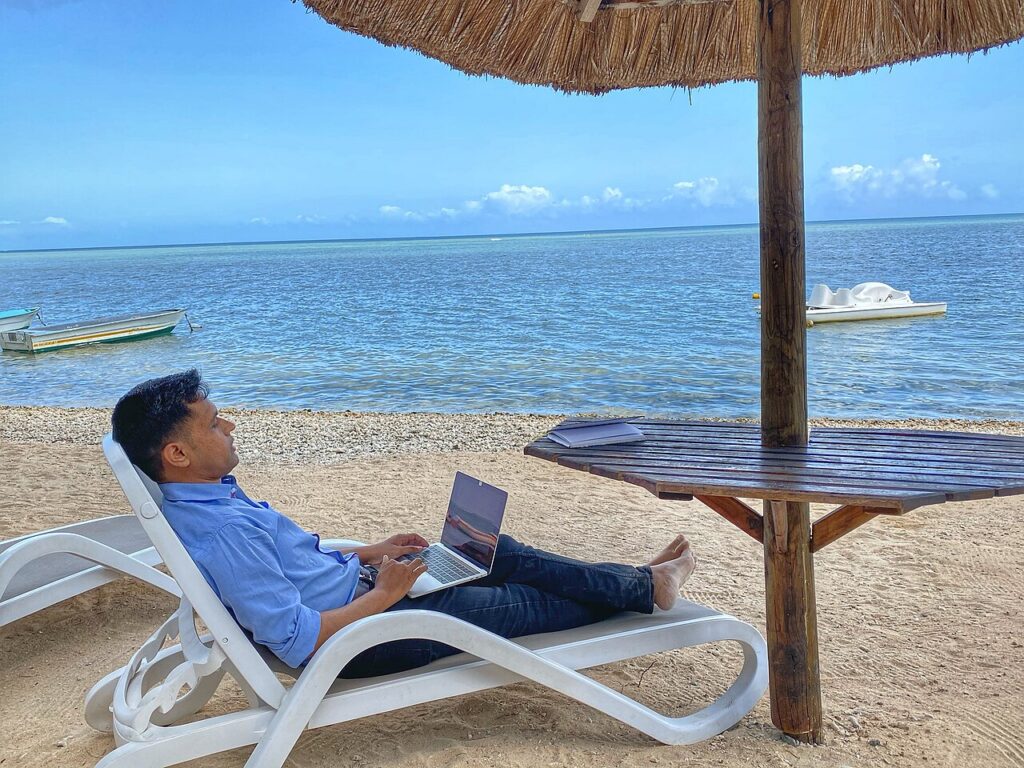
Most remote workers end up working from their condo on fibre and using a coworking space or café to get out. Day passes, monthly desks, business centres and café etiquette are covered on coworking spaces; providers, prices and sign up on home internet. Keep mobile data as a backup, and a small UPS for the router helps through short power cuts. See power and water outages.
Time zones for client calls
Thailand is UTC+7 all year. The gap to clients changes when they switch to summer time:
| Client in | Pattaya time, in their winter | Pattaya time, in their summer |
|---|---|---|
| London | 7 hours ahead | 6 hours ahead |
| Berlin or Paris | 6 hours ahead | 5 hours ahead |
| New York | 12 hours ahead | 11 hours ahead |
| Los Angeles | 15 hours ahead | 14 hours ahead |
| Sydney | 3 hours behind | 4 hours behind |
A 9am New York meeting is 9pm in Pattaya in the northern winter. Europe fits the Thai afternoon and evening; Asia and Australia fit the Thai working day.
Phones, money and tax
- Two numbers: a Thai number for local life and apps, plus a way to keep your home number for bank and verification codes.
- Banking: banks tightened account opening in 2026, and Kasikorn now lists the DTV among visas it doesn’t accept for new savings accounts. Many DTV holders rely on a home bank card and a travel or multi currency card instead. See Thai bank account, ATM fees and sending money to Thailand.
- Tax: the DTV gives no tax exemption. Staying 180 days or more in a calendar year usually makes you a Thai tax resident, and foreign income you bring into Thailand may then be taxable. A proposed relief for remitted income was still not in force when we checked. Get advice for your situation; see Thai tax basics.
- Health: insurance isn’t a DTV requirement, but hospital bills are real. See health insurance.
Pro tip: I run two numbers on one iPhone: a dtac Thai number I’ve had for nine years, and my US number, which I’m moving back to Google Voice. On an earlier visit I couldn’t set Google Voice up from Thailand; once it was set up at home in the US, it worked here.
Budget
A single person typically spends about ฿30,000 to ฿65,000 a month including rent, depending on the condo and how often you go out. Add coworking, software and a trip out of Thailand at least once a year on a DTV. See monthly budget examples and cost of living.

Staying productive
- Set work hours and protect them. Late nights out are the classic Pattaya productivity killer; see nightlife on a budget.
- A one bedroom with a door between desk and bed helps on long days.
- Meet people through coworking spaces, gyms and expat groups. See expat clubs and gyms and fitness.
- Plan around rainy season storms for important calls. See flood season.
Common questions
Is Pattaya good for digital nomads? For many people, yes: cheap fast internet, good value condos, the beach and the DTV. The community is smaller than in Bangkok, so you’ll make more effort to meet people.
Can I work remotely on a visa exemption? The DTV is the visa designed for remote work, so use the exemption to try Pattaya and apply for the DTV before you settle. Working for Thai clients or companies always needs a work permit.
What time zone is Pattaya? UTC+7 all year, with no daylight saving, so the gap to Europe and the Americas changes by an hour when they change clocks.
Do I pay Thai tax as a digital nomad? Possibly. Staying 180 days or more in a calendar year usually makes you tax resident, and foreign income you bring in may be taxable. Get professional advice.
Sources
Checked 13 November 2026: visa, internet and coworking figures come from our DTV, visa extension, home internet and coworking pages, each checked against official and press sources this month. Tax: Thai Law Online, foreign income remittance tax in 2026, updated 10 November 2026, which says the post 2024 remittance rule still applies and a proposed exemption has not been published in the Royal Gazette; we found no Revenue Department announcement saying otherwise. Budget ranges are from our monthly budget examples. Jonny’s phone setup is in his own words. General information, not legal or tax advice.
Useful next steps
- See coworking spaces.
- See the DTV visa.
Related pages


Ride along with Jonny
Every guide page comes from the nightly rides through Pattaya. Watch them, ask questions in the community, or help keep the camera rolling.
Watch the rides Join the Telegram Leave a tip Support the rides

 ไทย
 中文
 Русский
 한국어
 Deutsch
 Français