

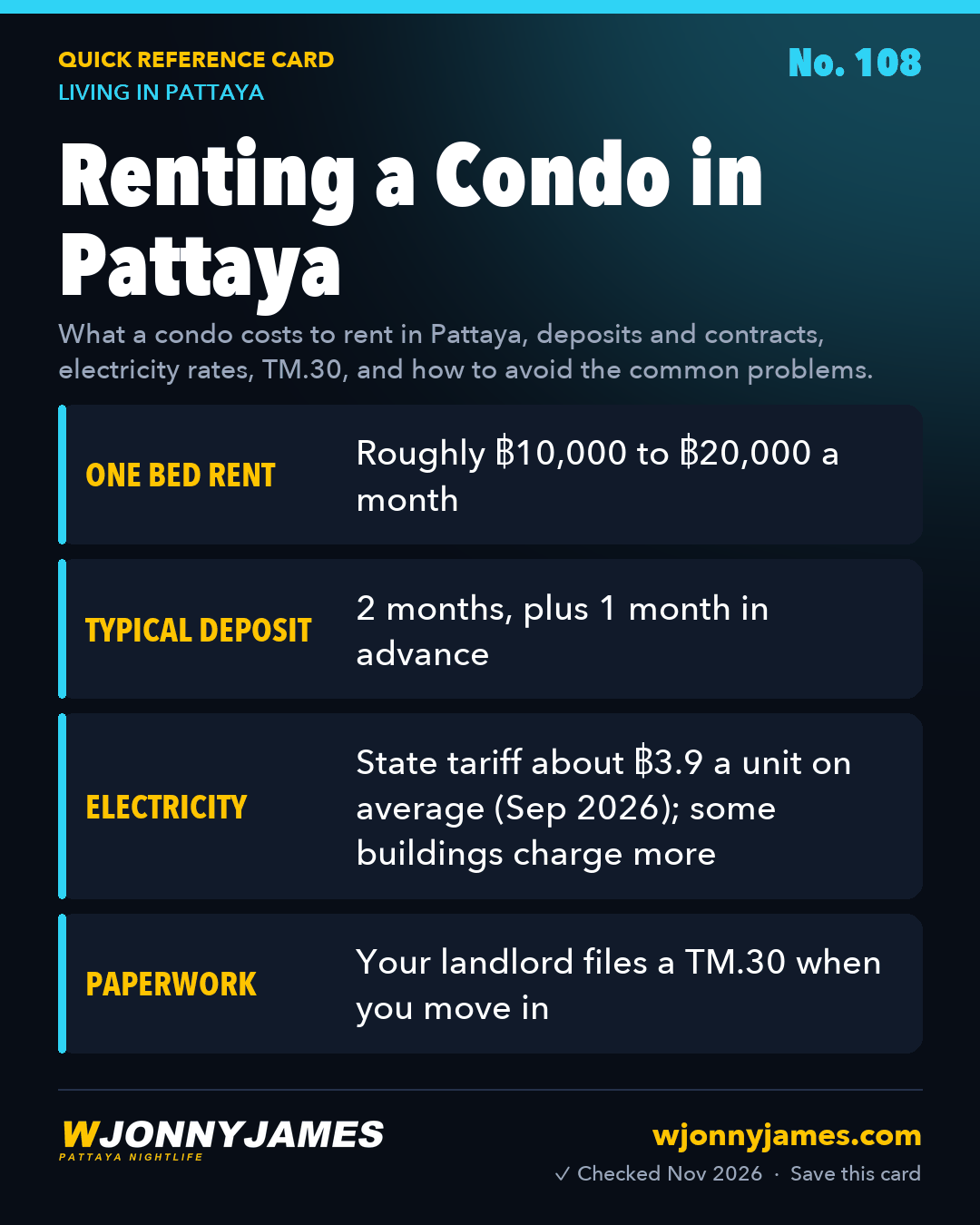
Quick answer: Most one bedroom condos in Pattaya rent for about ฿10,000 to ฿20,000 a month on a one year lease, with studios in older buildings from about ฿7,000 and sea view units on the beach roads often ฿30,000 or more. Expect to pay two months’ deposit plus the first month in advance, then electricity on top. Ask the price per electricity unit before you sign, get a written contract, photograph everything on day one, and make sure the owner files your TM.30 with immigration.
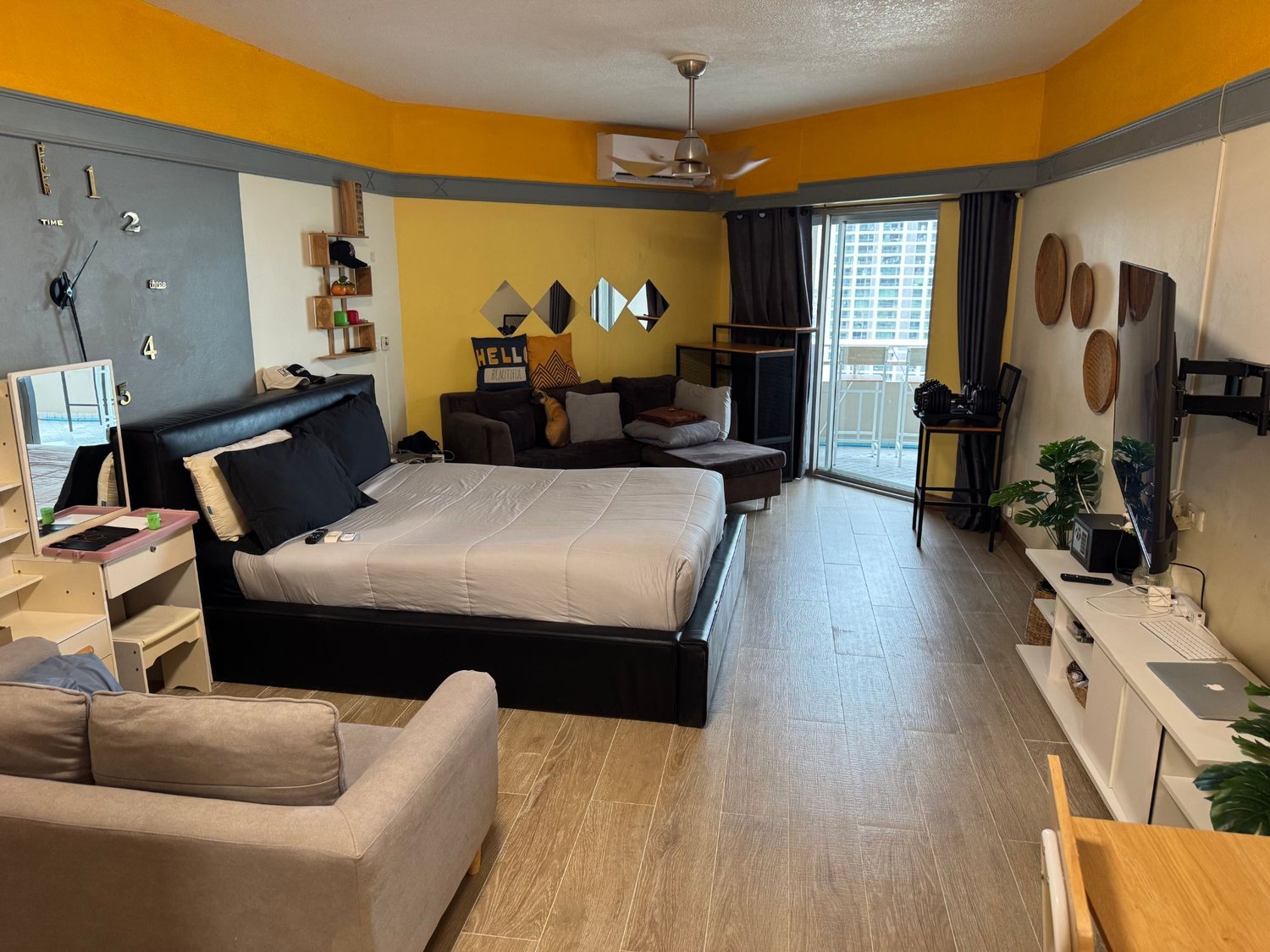
Most foreigners who stay in Pattaya for more than a few weeks rent a condo. There are thousands to choose from, and with a little care it’s straightforward. These are the things to know before you sign.
At a glance
| What | Typical | Worth knowing |
|---|---|---|
| Studio, older building | From about ฿7,000 to ฿8,000 a month | Usually away from the beach |
| One bedroom, one year lease | About ฿10,000 to ฿20,000 a month | The most common rental |
| Beachfront tower, sea view | Often ฿30,000 to ฿40,000 or more | Views can be partly blocked by newer towers |
| Two bedroom condo or small villa | About ฿20,000 to ฿40,000 a month | More space for couples and families |
| Deposit | 2 months’ rent | Plus the first month in advance |
| Electricity | About ฿3.9 a unit on average on your own meter | First 200 units capped at ฿3; some buildings charge a higher flat rate |
| Lease length | 1 year is standard | Monthly and short lets cost more per month |
These are rough 2026 ranges from rental listings and my own rentals, not quotes. Prices move with the season.
What it costs
- Studios start around ฿7,000 to ฿8,000 a month in older buildings away from the beach.
- One bedroom condos typically rent for about ฿10,000 to ฿20,000 a month on a one year lease.
- New buildings, sea views and beachfront locations cost more. Soi Buakhao and Jomtien’s back streets are usually cheaper than Pratumnak or Wong Amat.
- Monthly and short lets cost more per month than a one year contract. Booking a month on a holiday rental site is the easy way to try an area first, but it is the most expensive way to stay long term.
- High season, roughly November to March, is when owners are least willing to negotiate. In the rainy low season you have more choice and more room to ask for a lower rent, especially on a longer lease.
How much space for your money
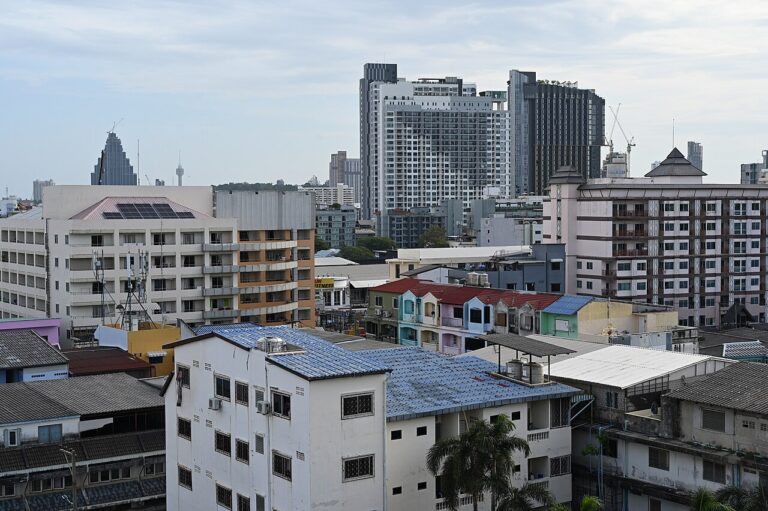
The same budget buys very different things depending on the street. A one bedroom with a partial sea view in a tower on Beach Road can cost about double what a similar unit costs a few streets back, and it may be only a short walk closer to the places you actually go. Off the main strip, a condo can be about ฿10,000 a month instead of ฿30,000 to ฿40,000.
Think about the walk, too. A building that sits a five or six minute walk down a side street from the main road is fine on day one, but if you make that walk two or three times a day in the heat, it starts to add up. If you don’t drive a scooter, check how far it is to the nearest baht bus route. See baht bus routes and fares.
Deposits and contracts
- For a one year lease, two months’ deposit plus one month’s rent in advance is common. Short lets often ask for less.
- Get a written contract that says the rent, the deposit, what’s included and what happens if you leave early. Leaving before the end usually costs you the deposit.
- Walk round with the owner or agent before moving in and photograph everything, including marks and damage, so there’s no argument at the end.
- In most cases the owner pays the agent’s commission, not you.
- Read the whole lease before you sign. I compared three of my own Pattaya leases, clause by clause, on what’s normal in a condo lease and what to watch for.
- Never transfer a deposit for a unit you haven’t seen, or to someone who can’t show they own or manage it. Fake listings that copy real photos are a known trick. See common scams.
Your rights under the 2025 lease rules
Since 4 September 2025, a consumer protection notification covers landlords who rent out three or more homes. It replaced an older 2019 version that only covered landlords with five or more units. Under it:
| Rule | What it says |
|---|---|
| Deposit and advance rent | No more than three months’ rent in total for monthly paid leases |
| Getting your deposit back | Immediately at the end, or within 7 days if the landlord needs to inspect, or 14 days if repair costs are deducted |
| Electricity and water | Can’t be charged above the official government tariffs |
| Leaving early | On a fixed term lease, after living there for at least half the term, with 30 days’ notice and everything paid |
| Visits | The landlord can’t come in without notice, except in an emergency |
| Contract | Must be written in clear Thai |
Many Pattaya condos are let by private owners with one or two units, and they may not be covered. Ask for the same points in your contract anyway: a fair deposit, a return date, the electricity rate and the notice period.
A lease longer than three years must be in writing and registered at the Land Office to be enforceable beyond three years. For a normal one year rental this doesn’t apply. This is general information, not legal advice.
Bills
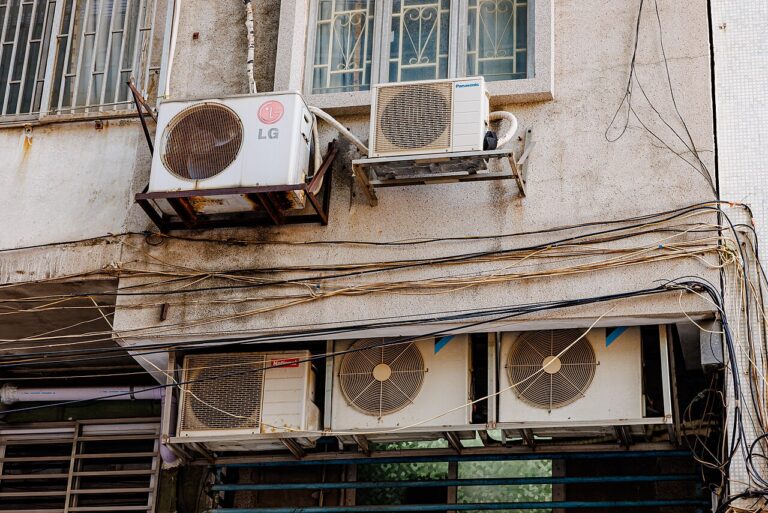
- Electricity is the big one, because of aircon. On a unit with its own PEA meter you pay the state tariff: since September 2026 the first 200 units a month cost no more than ฿3 each, with an average across all users of about ฿3.89 a unit before VAT. Some buildings and owners charge their own flat rate instead, which can be higher. Ask the rate per unit before you sign.
- Water is usually cheap, often charged per unit or as a flat fee.
- Internet is either included or a monthly contract of a few hundred baht.
- The building’s common area fee is normally paid by the owner. Check the contract.
- Buildings that bill you themselves can charge well above the state rate. One building I lived in charged ฿6 a unit for electricity and ฿40 a unit for water in 2024.
- Read the meters with the owner on the day you move in, and photograph them.
For real numbers, see my own bills on utilities and bills and how to bring them down on saving electricity.
Small repairs can turn into big ones. Our ฿699 water heater swap is a good example of why it’s worth agreeing who fixes what.
Check the owner’s common fees
Condo owners pay the building a monthly common area fee for security, cleaning, the lifts and the pool. If the owner stops paying, it can become your problem.
In 2024 I rented a unit whose owner had fallen behind. The building’s invoice to the owner showed ฿25,401.60 in unpaid common fees going back to August 2023, before I’d even moved in, plus a ฿774.60 late penalty and a ฿1,058.40 surcharge for debt more than six months old. With that month’s water and electricity, the total was ฿28,918.60. The building threatened to cut off our water. The owner worked it out in the end and we were fine, but it was a stressful situation.
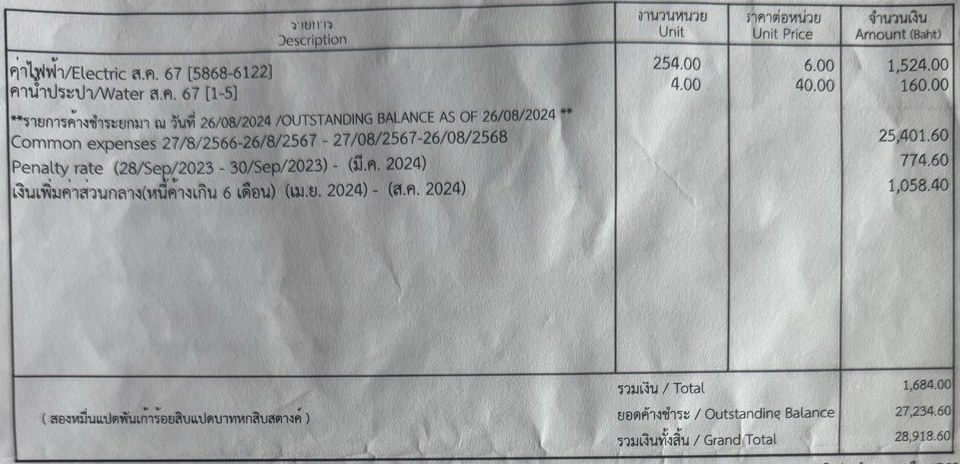
The building’s invoice to the owner, with names and addresses removed: two years of unpaid common fees, a late penalty and a six month arrears surcharge.
- Under Thailand’s Condominium Act, the building can add surcharges to an owner’s unpaid common fees, and once they’re more than six months overdue it can stop the owner using common services. In practice that’s where threats like cutting the water come from.
- Before you sign, ask the building office (the “juristic office”) whether the unit’s common fees are paid up. If they aren’t, wait until the owner clears them, or get it in writing that the owner will.
- Check your lease says who pays the common fees. It’s normally the owner.
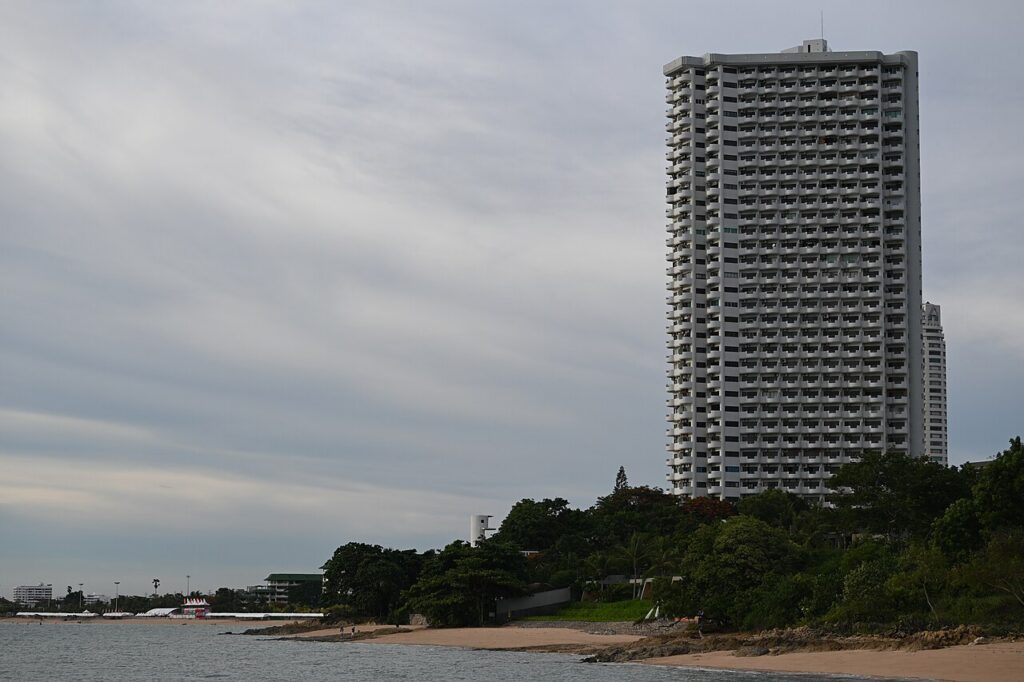
TM.30 and immigration
When a foreigner moves in, the owner has to report it to immigration on a form called the TM.30, usually within 24 hours. Ask for a copy of the receipt. You’ll need proof of address for visa extensions and 90 day reports at the Jomtien immigration office. See TM.30 explained for who files and what happens if nobody does.
Finding one
- Walk around the area you like and ask at the building’s office (the “juristic office”). They often know which units are free.
- Facebook rental groups and property websites have thousands of listings.
- Agents are useful if you want someone to do the searching, and you usually don’t pay them.
- Stay a week or a month somewhere first, then look in person. Photos rarely show the noise, the view that’s now blocked, or the lifts.
Before you sign
- Run the shower and taps, try every aircon unit and check the internet speed.
- Visit in the evening to hear what the noise is like.
- Check the parking if you have a scooter.
- Ask how many lifts there are for how many floors, and try them at a busy time.
- Ask whether pets are allowed. Many buildings say no, and an owner usually can’t override the building rules.
- Get the deposit return terms in writing.
Pro tip (as of Nov 2026): I rented a 15th floor studio at The Markland, on Soi 1 overlooking Soi 2. In my opinion it has the best view in Pattaya, over the city and the bay. I paid ฿15,000 a month for one unit, then about ฿19,000 to ฿20,000 for the one next door when I went back, and it was still worth it. The downside is that there are only two slow lifts for 20 odd floors. A studio also has no wall between the bedroom and living area, which is good to have, especially in a relationship. It isn’t pet friendly, so I can’t go back with my dog. When I looked at beachfront towers, a one bedroom with a partly blocked view was about double the price, and only a block closer to the places I go. If I rented again today, I’d likely take a condo for about ฿10,000. Personally, I like Central, North and South Pattaya, and the Darkside, Jomtien and Naklua feel too far from the excitement. But if you want to save money or only go out once a week, you can get more space, such as a house on the Darkside. Jomtien can save money too, and it’s a lighter experience. Learn some Thai and you may save more and get a more authentic experience outside the city.
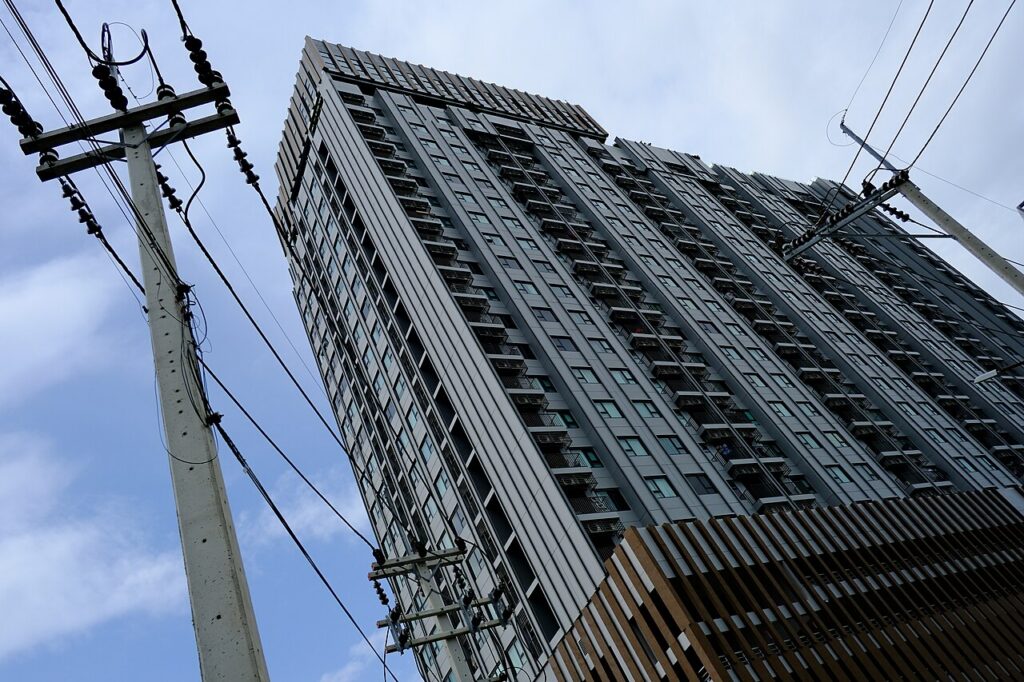
Choosing an area
- Central Pattaya and Soi Buakhao for value and nightlife, Jomtien and Pratumnak for calm and beaches, Naklua for local life. See where to stay.
- East Pattaya, across Sukhumvit Road, has more houses and space for the money, but you’ll want your own transport. See East Pattaya and renting a house.
- Check the noise: which side faces the road or a bar. See noise and sleep.
Moving in
- Photograph the room and meters on day one, and list any damage with the owner.
- Ask how to pay rent and bills. Most owners take a bank transfer or a QR payment. See utilities and bills and QR payments.
- Read the building rules. See condo living rules.
- Set up internet early. See home internet.
- Keep the contract, the TM.30 receipt and your deposit receipt together. You’ll want them at immigration and when you move out.
Moving out
- Give notice in writing, as your contract says.
- Clean, then walk round with the owner and compare against your day one photos.
- Read the meters together and settle the last bills.
- Agree in writing when the deposit comes back and what, if anything, is deducted. For landlords covered by the 2025 rules, that’s immediately or within 7 to 14 days.
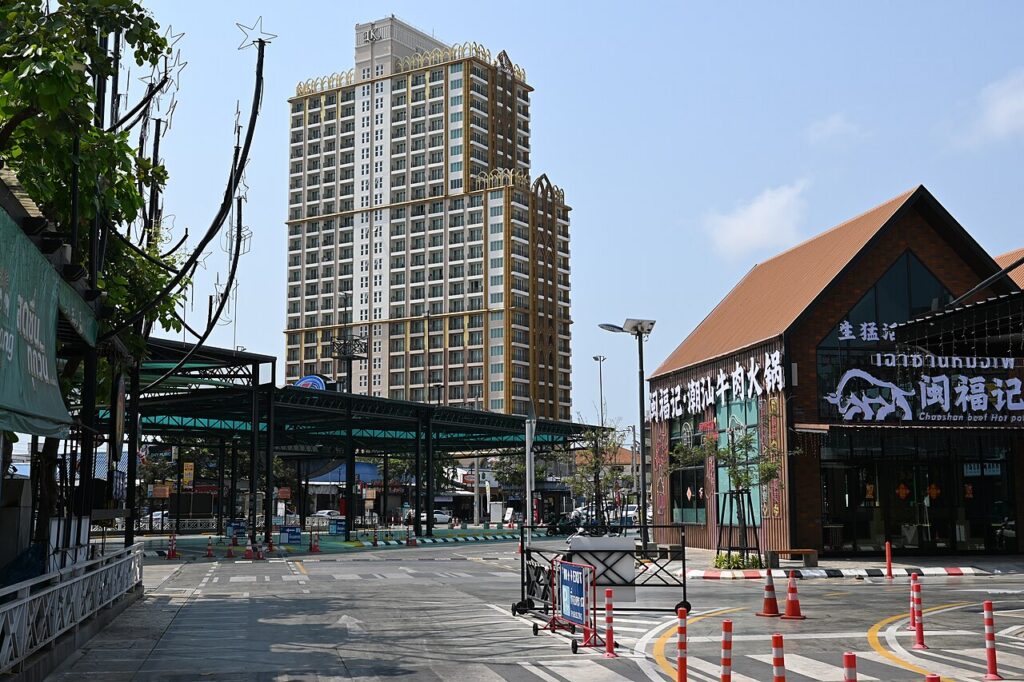
Thinking long term
- Compare renting with buying. I was paying about ฿20,000 a month when I worked out that within a couple of years my rent would have bought a place of my own. See buy or rent and buying a condo.
- See monthly budget examples and first week checklist.
Common questions
How much does it cost to rent a condo in Pattaya per month? About ฿10,000 to ฿20,000 for a one bedroom on a one year lease, from about ฿7,000 for a studio in an older building, and often ฿30,000 or more for a sea view unit in a beachfront tower.
How much deposit do Pattaya landlords ask for? Usually two months’ rent plus the first month in advance. Landlords with three or more homes are limited by the 2025 rules to three months’ rent in total.
Can foreigners rent a condo in Pattaya? Yes. You sign the lease with your passport, and the owner files a TM.30 report with immigration.
Is it cheaper to rent monthly or yearly? Yearly. A one year lease is cheaper per month than a monthly or short let, and owners are more willing to negotiate on a longer lease, especially in the low season.
Why is my electricity bill so high? Aircon, and sometimes the rate. Check whether you’re on your own PEA meter at the state tariff or on the building’s own rate, which can be higher. See saving electricity.
Sources
Checked 16 November 2026: Tilleke & Gibbins, the 2025 residential lease notification (August 2025); Civil and Commercial Code section 538, unofficial English translation; Nation Thailand, September power tariff and 3 baht cap (12 August 2026). Rent ranges come from rental listings and my own rentals, and change with season and demand. General information, not legal advice.
Related guides
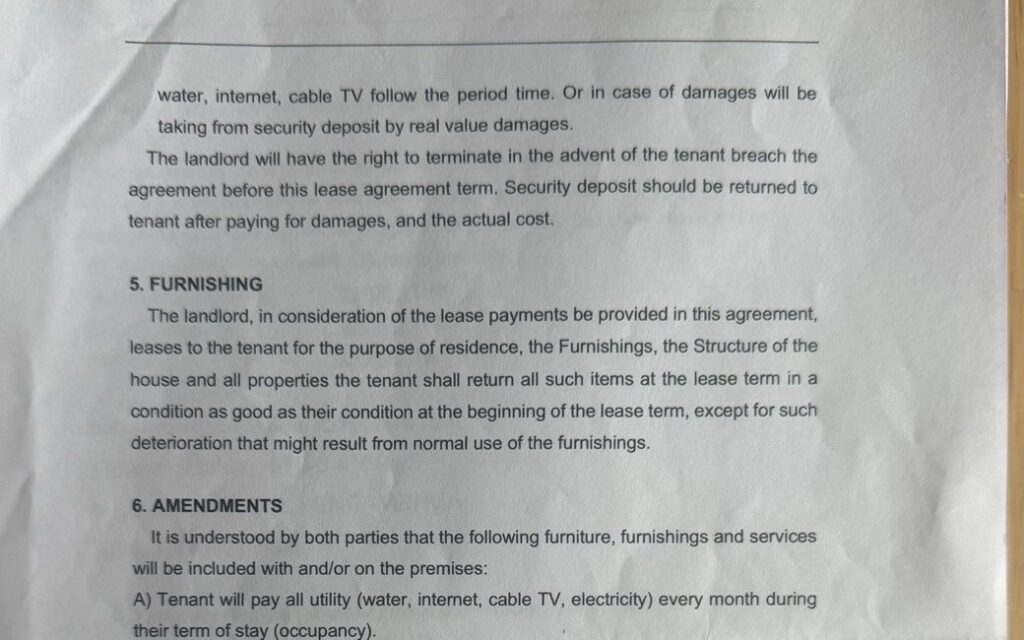 🏠 Living in PattayaThai Condo Leases: What’s Normal and What to Watch For
 🏠 Living in PattayaBuy or Rent in Pattaya?
 🏠 Living in PattayaRetiring in Pattaya
 🏠 Living in PattayaWintering in Pattaya: A Snowbird Guide
 🏠 Living in PattayaHome Repairs and Handymen in Pattaya
 🏠 Living in PattayaBuying a Condo in Pattaya as a Foreigner
 🏠 Living in PattayaRenting a House in Pattaya
 🏠 Living in PattayaSaving Money on Electricity
Related pages

Ride along with Jonny
Every guide page comes from the nightly rides through Pattaya. Watch them, ask questions in the community, or help keep the camera rolling.
Watch the rides Join the Telegram Leave a tip Support the rides

 ไทย
 中文
 Русский
 한국어
 Deutsch
 Français