

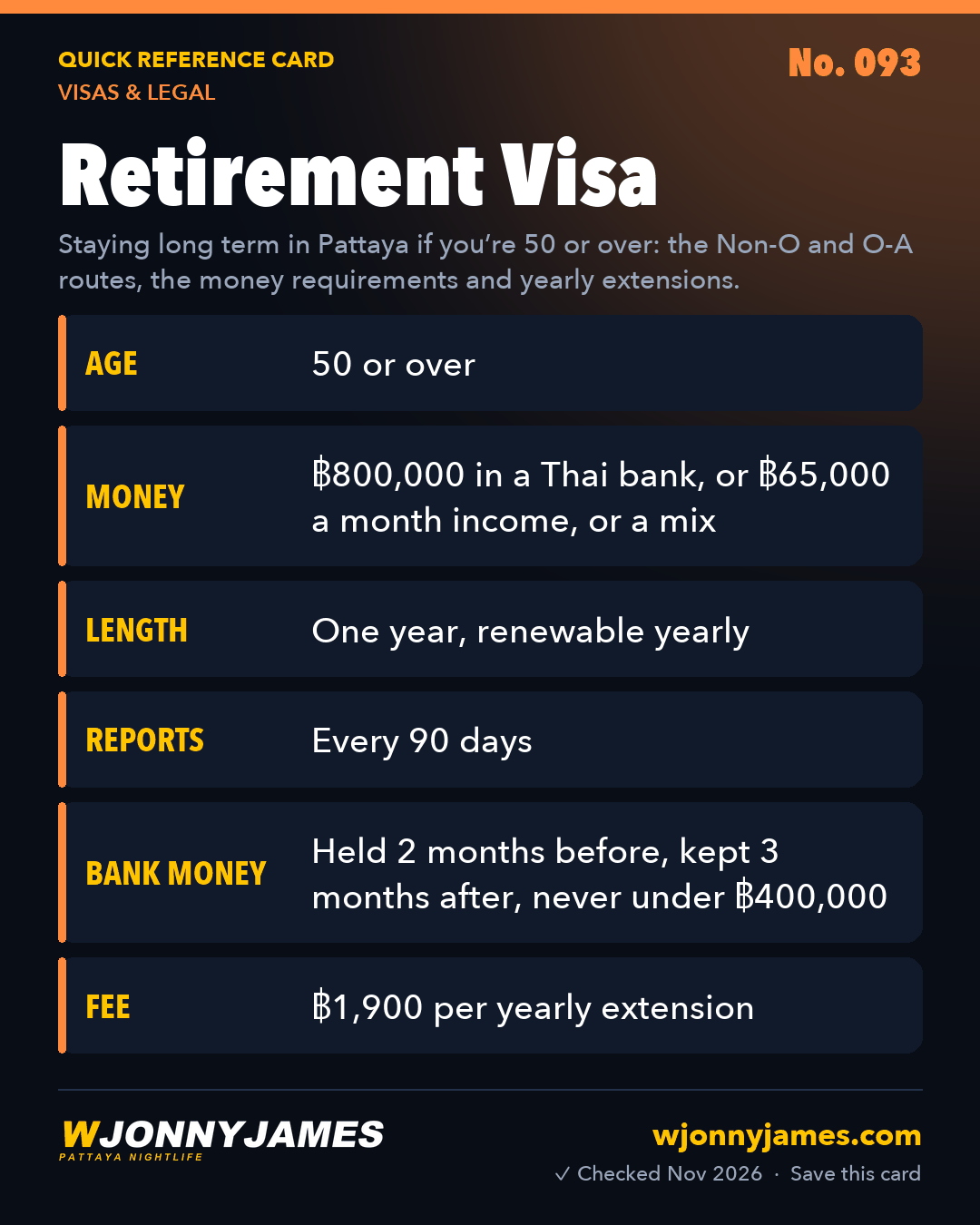
Quick answer: If you are 50 or over, you can live in Pattaya on a retirement based stay, renewed one year at a time at the Jomtien immigration office. You show either ฿800,000 in a Thai bank account, a monthly income of at least ฿65,000, or a mix adding up to ฿800,000 a year. The bank route has timing rules: the money is usually held for two months before you apply, kept there for three months after, and never allowed below ฿400,000. Each extension costs ฿1,900, and you still do 90 day reports and need a reentry permit to travel.

At a glance
| What | Detail |
|---|---|
| Age | 50 or over |
| Money | ฿800,000 in a Thai bank, or ฿65,000 a month income, or a mix totalling ฿800,000 a year |
| Bank timing | Usually 2 months before applying, 3 months after, never below ฿400,000 |
| Length | One year at a time, renewable |
| Fee | ฿1,900 per extension (form TM.7) |
| Reports | Every 90 days; reentry permit before trips abroad |
| Health insurance | Required for O-A; not usually for Non-O extensions in Thailand |
| Work | Not allowed |
The two main routes
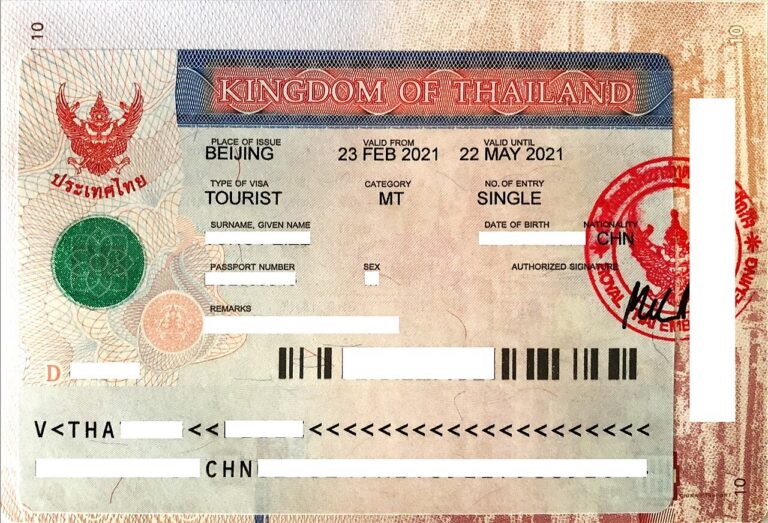
- Non-Immigrant O (retirement): get a Non-O visa from a Thai embassy, or convert from another entry inside Thailand where the office allows it, then extend for a year at a time at immigration. Health insurance usually isn’t required for extensions on this route.
- Non-Immigrant O-A: applied for from your home country, gives a year from the start, and requires health insurance. Sources describe a coverage guideline of around US$100,000. Some sources say the insurance rule also applies when O-A holders extend inside Thailand; ask immigration.
- Many people in Pattaya use the Non-O route because it avoids the insurance requirement. That doesn’t mean going without insurance is wise. See health insurance.
Non-O, O-A and O-X side by side
| Non-O (retirement) | O-A (long stay) | O-X (long stay) | |
|---|---|---|---|
| Where you apply | Thai embassy abroad, or convert inside Thailand | Thai embassy in your home country | Thai embassy, listed nationalities only |
| First stay | 90 days, then a one year extension | One year | Five years, renewable once (ten in total) |
| Money | ฿800,000, or ฿65,000 a month, or a mix | Same as Non-O | ฿3,000,000 in a Thai bank, or ฿1,800,000 plus ฿1,200,000 a year income |
| Health insurance | Not listed at the embassy; not usually asked at extension | ฿3,000,000 (US$100,000) cover per policy year | ฿3,000,000 cover, from a Thai insurer |
| Police and medical certificates | Not usually | Yes, issued within 3 months | Yes, issued within 3 months |
| Who it suits | Most Pattaya retirees | People who want everything sorted before they fly | Wealthier retirees from the 18 listed countries who want fewer renewals |
The O-X list on the Los Angeles consulate’s page: Australia, Austria, Belgium, Canada, Denmark, Finland, France, Germany, Italy, Japan, the Netherlands, New Zealand, Norway, South Korea, Sweden, Switzerland, the United Kingdom and the United States.
O-A health insurance, in plain terms
- Since 1 October 2021 the O-A rule is one figure: at least ฿3,000,000 (or US$100,000) of cover per policy year. The older ฿40,000 outpatient and ฿400,000 inpatient split no longer applies to the O-A; you will still see it quoted on older pages.
- For a new application, a Thai policy from an insurer on the official long stay list (longstay.tgia.org) works, and a foreign policy can work if the insurer completes the official Foreign Insurance Certificate.
- At extension time inside Thailand, offices generally expect a Thai policy. Whether a foreign certificate is accepted varies by office, so ask Jomtien before you renew.
- The policy has to cover the whole permitted stay. Preexisting conditions are often excluded or loaded, and premiums rise sharply with age, which is a big reason people switch to the Non-O route. See health insurance.
The money in detail
- Bank deposit: ฿800,000 in a Thai savings account in your name. Most offices want it seasoned for two months before you apply (some ask for three), kept at ฿800,000 for three months after approval, and never below ฿400,000 for the rest of the year. The bank gives you a letter and an updated passbook on or near the day you apply.
- Income: at least ฿65,000 a month, shown with an embassy income letter or, more often now, with evidence of the money being transferred into your Thai account from abroad every month.
- Combination: income times twelve plus the bank balance adding up to ฿800,000.
- Parking money just before the application and taking it out straight after is one of the most common reasons extensions are refused. See sending money to Thailand and opening a Thai bank account.
The yearly extension, step by step
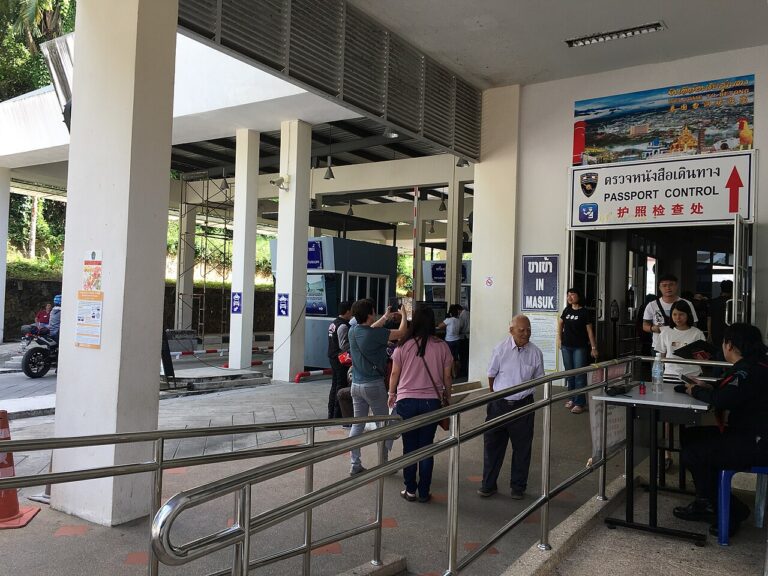
- Apply in the last 30 days or so of your current permission. Jomtien gives queue numbers early in the day.
- Bring: passport and signed copies, TM.7 form, a photo, the bank letter and passbook (or income evidence), your TM.30 receipt, proof of address such as a lease, and a map to your home if asked.
- Pay ฿1,900. Many offices stamp an “under consideration” note first and finish the full year stamp on a second visit about a month later.
- Keep every copy: next year the same officers may ask what you showed this year.
Your first year, as a timeline
| When | What happens |
|---|---|
| Before you fly | Decide Non-O or O-A. For O-A, gather the police certificate, medical certificate and insurance first. |
| Arrival | Enter on the Non-O (90 days) or O-A (one year). Your landlord or hotel files the TM.30. |
| Weeks 1 to 2 | Open a Thai bank account and move the money in. Banks have tightened the rules for short stay visas, so take your visa page and a lease. See Thai bank account. |
| Day 90 | First 90 day report, in person. |
| About 2 months before expiry | Make sure the ฿800,000 has sat untouched long enough for your office’s seasoning rule. |
| Last 30 days | Apply for the one year extension at Jomtien. Expect a second visit about a month later. |
| After approval | Keep ฿800,000 for three more months, then never below ฿400,000. Buy a reentry permit before any trip. |
What it costs each year
| Item | Typical cost |
|---|---|
| Extension of stay (TM.7) | ฿1,900 |
| Reentry permit | ฿1,000 single, ฿3,800 multiple. See reentry permit |
| 90 day reports | Free |
| Bank letter | A small fee at most banks; ask your branch |
| Photos and copies | Usually under ฿200 |
| Agent (optional) | Varies widely; get the full price in writing |
If something goes wrong
- The officer says your paperwork is short: ask exactly what is missing, write it down, and come back. Most problems are a missing copy or a bank letter dated on the wrong day.
- The extension is refused: you are usually given a short stay to leave Thailand. You can come back on another visa and try again later, but fix the cause first.
- The balance dipped below the rule: next year’s application can be refused even if the money is back. Don’t use the retirement account for daily spending; keep a second account for that.
- You overstayed: fines are ฿500 a day up to ฿20,000, and long overstays can lead to a ban. Sort it out at immigration before you try to leave. See leaving Thailand.
Living on it
- Report your address every 90 days. After the first in person report, many people do the rest online. See 90 day reports.
- Get a reentry permit before travelling abroad, or the extension is lost and you start again.
- You can’t work on a retirement visa, paid or unpaid. See working legally.
- Staying 180 days or more a year makes you a Thai tax resident. See Thai tax basics.
- Where to live: many retirees choose Jomtien for the quieter pace. See retiring in Pattaya.
Agents
Many people use a local visa agent the first time, to get the paperwork and bank letters right. A good agent explains what you need and still sends you to immigration in person. Be wary of anyone offering to “handle” the money requirement for you: arrangements that fake the deposit can cost you the visa if they come to light.
Other ways to stay if the retirement visa doesn’t fit
- Married to a Thai citizen: the marriage visa asks for ฿400,000 instead of ฿800,000, at any age.
- Under 50, or working remotely: the DTV.
- Prefer to pay than prove funds: Thailand Privilege.
- High income or assets: the government’s LTR visa has a “wealthy pensioner” category. Its rules changed in 2025 and sources disagree on the current figures, so check the Board of Investment’s LTR site directly.
Common questions
How much money do I need for a Thai retirement visa? ฿800,000 in a Thai bank, or ฿65,000 a month income, or a combination adding up to ฿800,000 a year.
How long must the ฿800,000 be in the bank? Usually two months before you apply, three months after approval, and never below ฿400,000 for the rest of the year. Some offices ask for three months before.
Do I need health insurance for a retirement visa? For the O-A visa, yes. For Non-O retirement extensions inside Thailand, it is usually not required, though it is strongly recommended.
Can I get a retirement visa under 50? No. Look at the DTV or Thailand Privilege. See visa options.
Can I work on a retirement visa? No, not even unpaid volunteering. You would need a different visa and a work permit. See working legally.
Can I leave Thailand during the year? Yes, but buy a reentry permit first. Without one, the extension ends the moment you leave.
Is the O-X worth it? Only if you are from one of the listed countries and can tie up ฿3,000,000 (or ฿1,800,000 plus income). It saves yearly renewals, but you still do 90 day reports.
Can I use money held abroad? Not for the bank route: it has to be in a Thai bank account in your own name. Joint accounts are often refused.
Sources
Checked 14 November 2026: Royal Thai Consulate General Los Angeles, Non-O, O-A and O-X retirement visas; The Thaiger, health insurance for the O-A visa (updated 26 August 2026); Lex Bangkok, Thailand retirement visa 2026; Thai Visa Services, retirement extension 2026; The Thaiger, retirement visa 2026. Office practice varies and rules change; check with Jomtien immigration. General information, not legal advice.
Related pages
Ride along with Jonny
Every guide page comes from the nightly rides through Pattaya. Watch them, ask questions in the community, or help keep the camera rolling.
Watch the rides Join the Telegram Leave a tip Support the rides

 ไทย
 中文
 Русский
 한국어
 Deutsch
 Français