

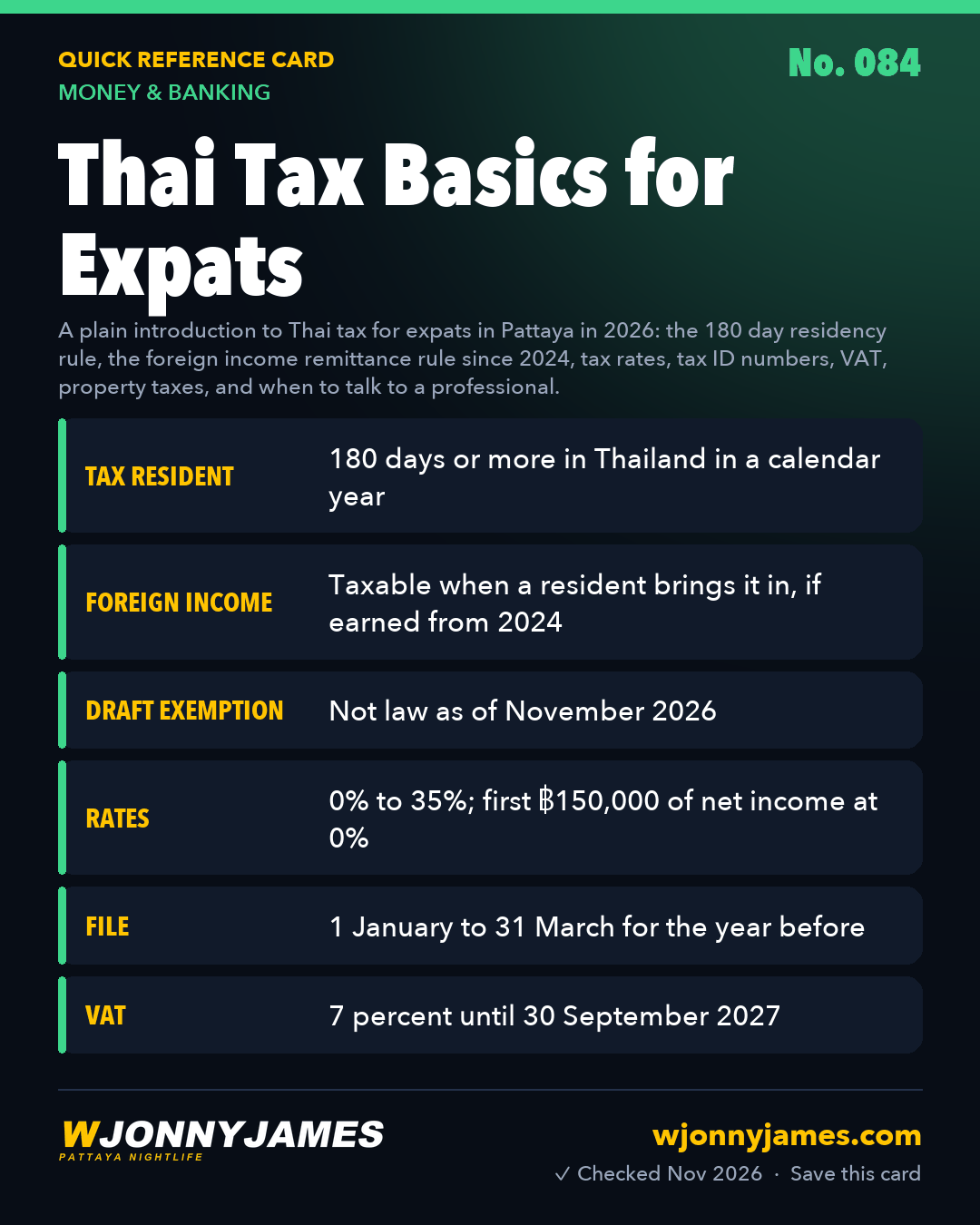
Quick answer: You become a Thai tax resident if you spend 180 days or more in Thailand in a calendar year. Since 1 January 2024, a tax resident can owe Thai tax on foreign income earned from 2024 onward when it is brought into Thailand, whatever year it arrives. Money earned before 2024 is protected, and tax treaties can reduce Thai tax on some income. A proposal to exempt foreign income brought in during the year it is earned or the following year was still a draft, not published in the Royal Gazette, as of November 2026. This page is general information, not tax advice; check with a qualified adviser.
At a glance
| Topic | What applies in 2026 |
|---|---|
| Who is resident | 180 days or more in Thailand in a calendar year, counted in total |
| Foreign income | Taxable for residents when brought into Thailand, if earned from 1 January 2024 |
| Money earned before 2024 | Not taxed when brought in; keep proof |
| Draft exemption | Income brought in the same year or the next would be exempt; not law yet |
| Rates | 0% on the first ฿150,000 of net income, rising in steps to 35% over ฿5 million |
| Filing | 1 January to 31 March on paper, a little later online |
| VAT | 7%, extended to 30 September 2027 |
Who is a Thai tax resident
The test is days, not visa or nationality. Spend 180 days or more in Thailand in a calendar year (1 January to 31 December) and you are a tax resident for that year. The days are counted in total across the year, so several shorter stays can add up. Someone on a retirement visa, the DTV or the Thailand Privilege visa who lives here most of the year usually is.
Nonresidents are normally taxed only on income from Thai sources, such as a Thai job or rent from a Thai property.
The foreign income rule since 2024
Revenue Department instruction Por. 161/2566 took effect on 1 January 2024. For a Thai tax resident, foreign income, such as wages, business profits, investment income, rent or a private pension, is assessable in the year it is brought into Thailand, no matter which year it was earned, as long as it was earned from 2024 onward. A second instruction, Por. 162/2566, keeps income earned before 1 January 2024 outside Thai tax when it is brought in.
What this means in practice:
- Savings built up before 2024 can be brought in without Thai tax, but you need to show they are pre 2024 money. Lawyers suggest keeping bank statements dated 31 December 2023, and some suggest holding pre 2024 savings in a separate account.
- Keep records of when money was earned and when it was sent. See sending money to Thailand.
The proposed exemption
In 2025 the Revenue Department proposed exempting foreign income brought into Thailand in the same calendar year it was earned, or the following year. As of November 2026 it was still a draft. Thai Law Online, a Thai law firm’s site, reported on 4 November 2026 that it had not been published in the Royal Gazette and was not in force. Don’t plan around it until it becomes law.
Tax treaties and pensions
Thailand has double tax agreements with more than 60 countries. Many treaties give the paying country the only right to tax government and public service pensions, while private pensions and investment income are often taxable in both, with a credit in Thailand for tax already paid abroad. Relief is not automatic: you usually claim it on your Thai return with proof of the foreign tax.
Holders of some categories of the Long Term Resident (LTR) visa have a separate exemption for foreign income brought in, set by royal decree. We found no special tax rule for the DTV.

Rates and filing
| Net income for the year | Rate |
|---|---|
| ฿0 to ฿150,000 | 0% |
| ฿150,001 to ฿300,000 | 5% |
| ฿300,001 to ฿500,000 | 10% |
| ฿500,001 to ฿750,000 | 15% |
| ฿750,001 to ฿1,000,000 | 20% |
| ฿1,000,001 to ฿2,000,000 | 25% |
| ฿2,000,001 to ฿5,000,000 | 30% |
| Over ฿5,000,000 | 35% |
The rates apply to net income after expenses and allowances, which include a ฿60,000 personal allowance. Returns for a tax year are due between 1 January and 31 March of the next year, so 2026 income is filed in early 2027. Online filing through the Revenue Department’s e filing system usually runs into early April.
Getting a tax ID number
You need a tax ID to file. Apply at the Revenue Department office covering your address, with your passport and proof of address. The Pattaya City Expats Club lists two offices for the Pattaya area, in Naklua (inside the Banglamung District Office) and in Jomtien. Its members’ reports differ on what was asked for, from just a passport and TM30 receipt to questions about days in Thailand and money brought in. Bring a Thai speaker if you can. See TM30 explained.
Taxes you pay every day
- VAT is 7% and is normally already in the price. The legal rate is 10%, but the 7% rate has been extended year by year; the latest extension runs to 30 September 2027.
- “++” on a menu means a service charge, usually 10%, and VAT are added to the listed prices. See tipping in Thailand.
Property
- Buying: at the land office, the transfer fee is usually 2% of the official appraised value, often split between buyer and seller by agreement. The seller usually pays withholding tax and either specific business tax (3.3%, if selling within five years) or stamp duty (0.5%). See buying a condo.
- Owning: owners pay a yearly land and building tax to the local authority. Residential rates start at 0.02% of the appraised value, so the bill on a typical condo is small, and homes used as the owner’s main residence can be exempt up to a value limit. Sources give different bands, so check your bill.
Getting help
Use a qualified Thai tax adviser or accountant, bring records of your days in Thailand, when income was earned and when it was sent, and check your home country’s rules too. If you work legally here, your employer deducts tax each month. See working legally.
Common questions
Do I pay tax in Thailand if I stay less than 180 days? Usually not on foreign income. Below 180 days in a calendar year you are not a tax resident, and nonresidents are normally taxed only on Thai source income.
Is my pension taxed in Thailand? It can be, if you are a tax resident and bring it in. It depends on the type of pension and your country’s tax treaty: many treaties leave government pensions to the paying country. Get advice for your treaty.
Has the foreign income exemption passed? Not as of November 2026. It was still a draft and had not been published in the Royal Gazette.
Sources
Checked 13 November 2026: Thai Law Online, remittance tax exemption status (updated 4 November 2026: draft, not in the Royal Gazette; Por. 161/2566 and 162/2566; filing); Thai Law Online, foreign sourced income and remittance tax (pensions and treaties, LTR, pre 2024 records); Lex Bangkok, personal income tax for foreigners (rates, allowance, residency, treaties; reviewed September 2026); Pattaya City Expats Club, Pattaya revenue offices (members’ reports, including August 2026); Nation Thailand, 7% VAT extended to September 2027; Keller Henson, property taxes for foreigners (transfer costs and land and building tax; updated February 2026). Sources differ on land and building tax bands and on what Pattaya’s revenue offices ask for. This is general information, not tax or legal advice.
Related guides



Related pages
 💸 Money & BankingATM Fees in Thailand
 💸 Money & BankingDepositing Cash at 7-Eleven
 💸 Money & BankingBest Exchange Rates in Pattaya
 💸 Money & Banking7-Eleven Stamps in Thailand: What They’re For and How to Use Them
 💸 Money & BankingCash, Cards or QR? Paying in Pattaya
 💸 Money & BankingOpening a Thai Bank Account
Ride along with Jonny
Every guide page comes from the nightly rides through Pattaya. Watch them, ask questions in the community, or help keep the camera rolling.
Watch the rides Join the Telegram Leave a tip Support the rides

 ไทย
 中文
 Русский
 한국어
 Deutsch
 Français