

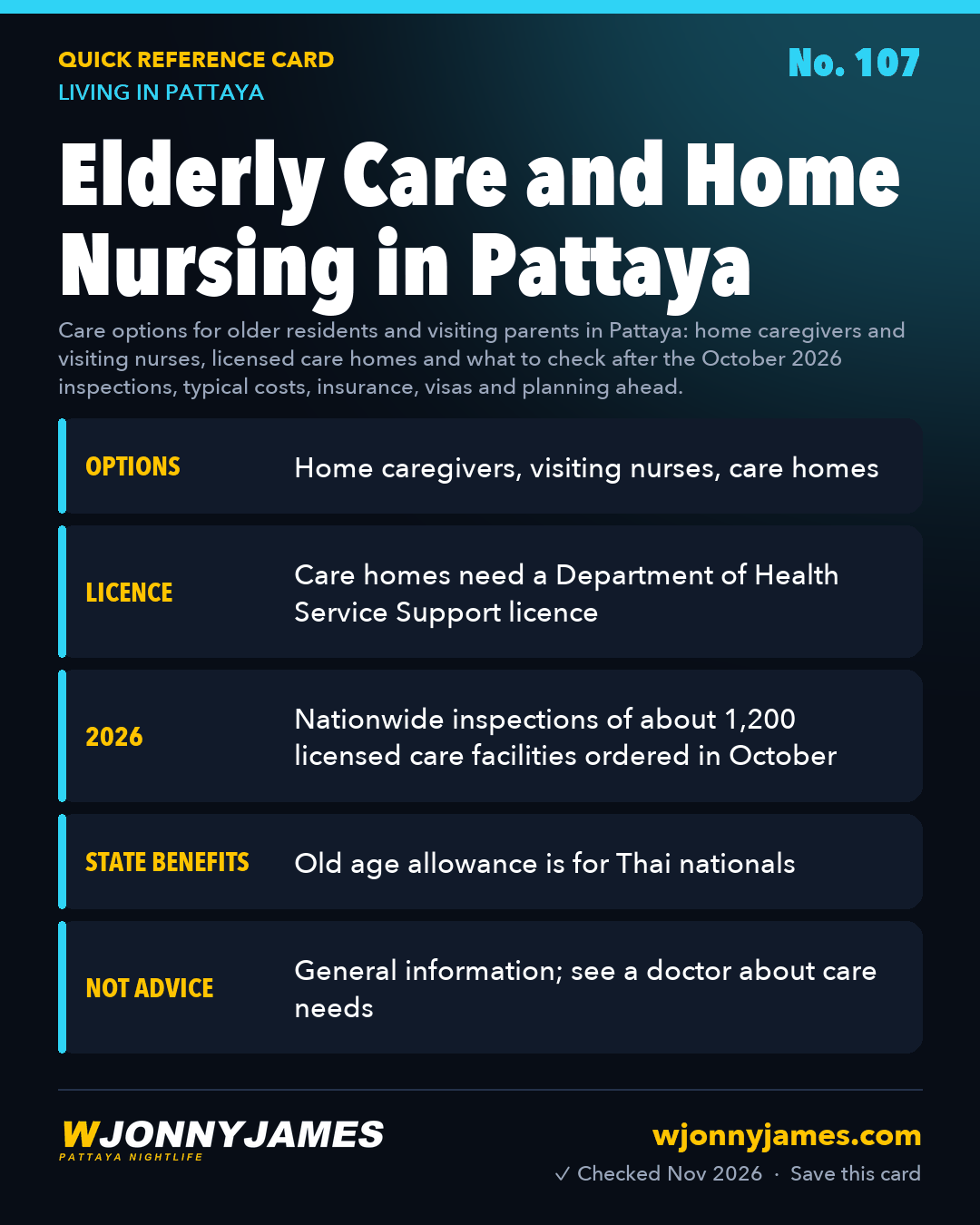
Quick answer: Older people in Pattaya can get help at home from a caregiver or a visiting nurse, or move into a care home or assisted living residence. Care homes in Thailand must hold a licence from the Department of Health Service Support (DHSS), and in October 2026 the government ordered inspections of all 1,203 registered care facilities after an abuse case, so always ask to see the licence. Costs vary widely, from the low tens of thousands of baht a month for shared or part time care to well over ฿100,000 for 24 hour one to one care. Thai state elderly benefits are for Thai nationals, so plan for private costs, insurance and a visa that fits. This page is general information: talk to a doctor about the level of care someone needs.

At a glance
| Option | Suits | Things to check |
|---|---|---|
| Part time caregiver at home | Help with meals, bathing, errands, company | Training, references, hours, cover for days off |
| Live in caregiver | Someone who needs help day and night | Room and food, rest day, legal status to work |
| Visiting nurse | Wound care, injections, care after a hospital stay | Nursing licence, which hospital or agency they work through |
| Care home or nursing home | Daily care with staff on site | DHSS licence, licensed bed count, night staffing, hospital transfer plan |
| Assisted living or retirement residence | Independent people who want support nearby | What care is included, what costs extra, contract and deposit |
Care at home
Many families start with care at home. A caregiver helps with meals, bathing, mobility and company, part time or live in; visiting nurses handle medical tasks after a hospital stay. Ask the hospital where the person is treated whether it can arrange home nursing, physiotherapy or equipment such as a hospital bed. See hospitals and clinics and registering at a hospital.
When you interview a caregiver or agency:
- Ask about training, past jobs and references you can call.
- Agree hours, tasks, a weekly rest day and what happens when they are sick.
- If you hire a non Thai worker directly, they need a valid work permit. See working legally.
- Thailand’s 2024 rules for domestic workers set a minimum wage, at least one rest day a week, paid public holidays and paid sick leave. Our maids and cleaning page has the details.
Care homes and assisted living
A licensed care home must stay within the beds and services on its licence. A day care centre provides care without overnight stays; a nursing home provides care with overnight stays. In October 2026, after complaints that residents of care facilities had been confined and assaulted, the government ordered on site inspections of all 1,203 care facilities registered with the DHSS within two months, checking premises, safety systems, qualified staff and services. The same month a home in Kanchanaburi had its licence revoked for taking more residents than its licence allowed and admitting psychiatric patients without authorisation.
What to check before you choose:
- Ask to see the DHSS licence, and compare the number of beds with what the licence allows.
- Visit more than once, at different times of day, including evening. Meet the staff, talk to residents and families, and try the food.
- Ask how many caregivers are on duty per resident, especially at night. A guide published in October 2026 notes that Thai law sets no minimum staff ratio.
- Ask which hospital they use and how fast they can transfer someone.
- Get an itemised quote (room, care hours, medicines, supplies, laundry, doctor visits) and read the deposit and notice terms. Ask about a trial stay.
- If a home looks unlicensed, unsafe or overcrowded, you can report it to the provincial public health office.

What it costs
We couldn’t find reliable published prices for Pattaya care homes, so get quotes. As a guide, a review of Thai retirement homes published in October 2026 gives:
- Full time private nurse: about ฿37,500 a month. Part time nursing about ฿12,500 a month for 8 hours a day, or ฿25,000 for 16 hours.
- Home care agencies in Bangkok: about ฿1,200 for a 4 hour visit and ฿3,500 a day for 24 hour live in care.
- Full service retirement homes in Chiang Mai: from about ฿52,000 a month before nursing care, with 24 hour one to one care adding over ฿100,000.
- Shared, budget arrangements: from the low tens of thousands of baht a month.
Agencies cost more than hiring directly, but check staff and send replacements. Many homes ask for a deposit of about one month’s fee plus the first month in advance. See hospital costs.
Health insurance and money
Health insurance gets harder to buy and more expensive with age. Many Thai policies stop taking new members at about 65 to 75, and conditions you already have are often excluded. The O-A retirement visa needs cover of at least ฿3,000,000 or US$100,000. Keep an emergency fund you can reach quickly, because private hospitals may ask for a deposit before treatment. See health insurance.
Visas for older residents and visiting parents
- People aged 50 and over who meet the money rules can live here on a retirement visa, extended yearly.
- A parent coming to visit can usually enter visa free for 30 days (since 15 September 2026) and extend once by up to 30 days for ฿1,900. See visa extension.
Planning ahead
- Keep a one page sheet with medicines, allergies, conditions, doctor and hospital, insurance details and emergency contacts. Give copies to the care home or caregiver.
- Register at your chosen hospital before you need it.
- Discuss wishes for treatment, and who can make decisions, while everyone is well. Ask a lawyer about a Thai will and power of attorney.
- Loneliness is a real risk for older people living far from family. Clubs and regular routines help. See expat clubs and mental health support.
- Ambulance: 1669. See emergency numbers.
Common questions
Are care homes in Thailand regulated? Yes. Care homes and day care centres for older people need a licence from the Department of Health Service Support under the Health Establishment Act 2016. All registered facilities were ordered to be inspected from October 2026.
Can foreigners use Thai state elderly care? Generally not. State benefits such as the old age allowance require Thai nationality, so foreign residents should plan to pay privately or through insurance.
Can my parent visit and stay for a few months? On a visa free entry they get 30 days, extendable once by up to 30 days. Longer stays need a visa. People aged 50 and over may qualify for a retirement visa.

Sources
Checked 13 November 2026: The Nation, government orders checks on 1,203 elderly care facilities (11 October 2026); The Nation, Kanchanaburi nursing home licence revoked (October 2026); Thailand.go.th, registering a care business for older or dependent people; Thailand Starter Kit, choosing a retirement home (October 2026) (cost figures and checklist); Thailand.go.th, Senior Living Allowance registration (Thai nationality required); ILO, Thai domestic work rules (revised June 2025); Pattaya Mail, Pattaya as a long stay retirement city (April 2026). Insurance and visa figures match our health insurance and visa extension pages, checked the same day. Cost figures are mostly from Bangkok and Chiang Mai, not Pattaya. General information, not medical, legal or financial advice.
More for retirees
See retiring in Pattaya and accessible Pattaya.
Useful next steps
- See hospitals and clinics.
- See accessible Pattaya.
Related pages




Ride along with Jonny
Every guide page comes from the nightly rides through Pattaya. Watch them, ask questions in the community, or help keep the camera rolling.
Watch the rides Join the Telegram Leave a tip Support the rides

 ไทย
 中文
 Русский
 한국어
 Deutsch
 Français