

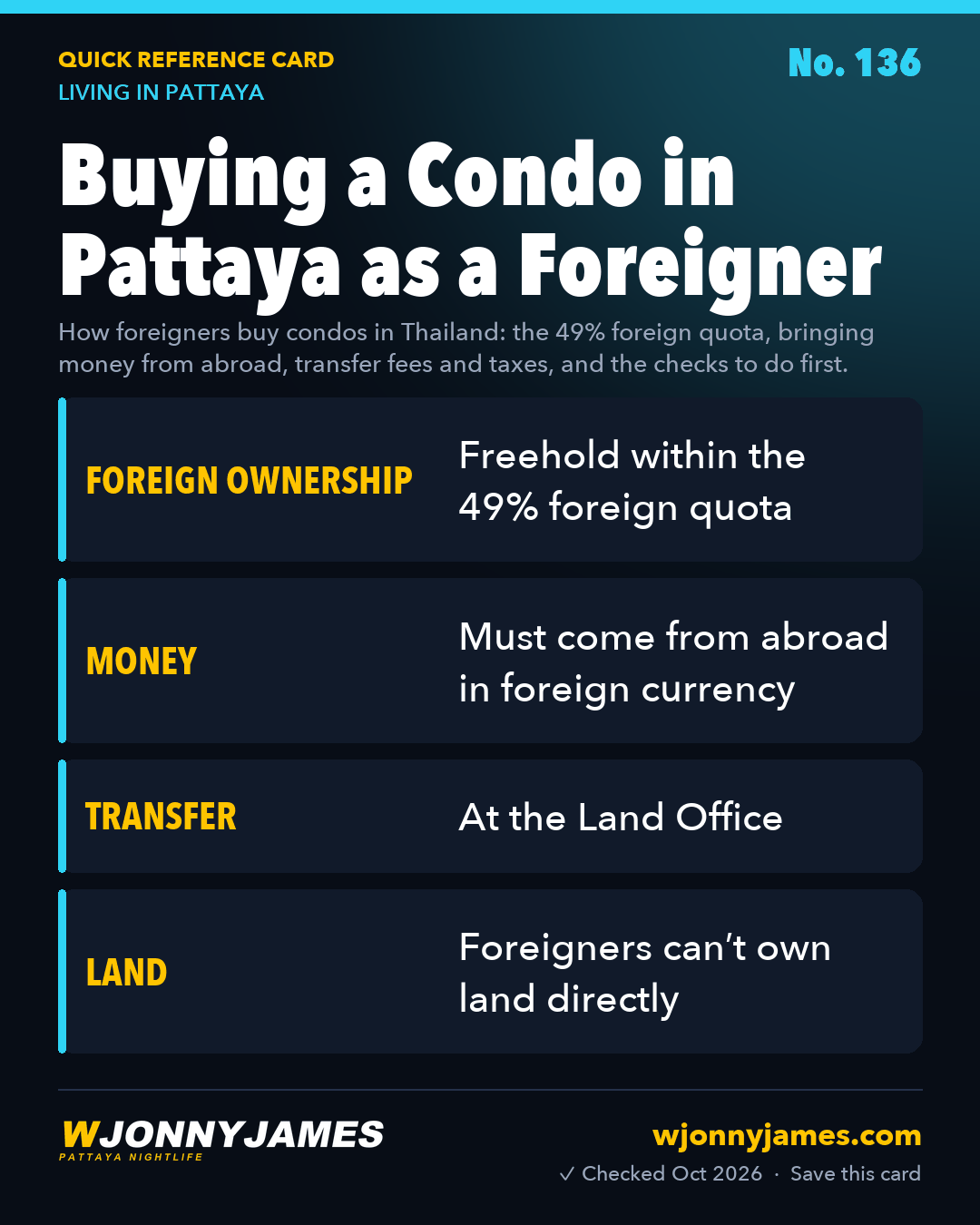
Quick answer: Foreigners can own a condo unit in Thailand outright (freehold), in their own name, as long as living-in-pattaya/buy-vs-rent/">foreign ownership in the building stays within 49% of the total sellable area. The money has to come into Thailand from abroad in foreign currency, and the Land Office needs proof: an FET form from your Thai bank for transfers of US$50,000 or more, or a bank letter for smaller amounts. The Land Office charges a 2% transfer fee on its appraised value, usually split with the seller; the 0.01% cut running to 30 June 2027 is for Thai buyers only. Renting first is often wise, use your own lawyer, and check the building before you pay a deposit. See renting a condo.
At a glance
| Step | What happens |
|---|---|
| 1. Check the quota | Get written confirmation from the building’s juristic office that foreign quota is free |
| 2. Reserve | A deposit, often 1% to 2% for resale; Jonny paid 10% |
| 3. Contract | Sale and purchase agreement, checked by your own lawyer |
| 4. Send money | From abroad, in foreign currency, into your own Thai account, with the purpose stated |
| 5. Get proof | FET form (US$50,000 or more) or a bank letter |
| 6. Transfer day | At the Land Office: pay fees, sign, leave as the owner |
The foreign quota
- Foreigners can own condo units freehold as long as foreign ownership in the building stays within 49% of the total sellable area.
- The quota is per building. Before you pay anything, ask the juristic office (the building’s management body) for a letter confirming there is room. Deals do fall through because the quota turned out to be full.
- If the foreign quota is full, units are only available on a Thai quota basis, typically as long leases, which give you fewer rights.
- Proposals to raise the quota or allow 99 year leases are not law as of November 2026.
Bringing in the money
- The purchase money must be transferred into Thailand from abroad in foreign currency, and converted to baht here.
- Send it into an account in your own name and state the purpose, such as “purchase of a condominium unit”. See opening a Thai bank account and sending money to Thailand.
- For a transfer of US$50,000 or more, the bank issues a Foreign Exchange Transaction form, the FET. Below that, banks usually give a confirmation letter instead. Jonny came away with both an FET form and a letter from his bank.
- Keep these papers safe. You will need them again if you sell and want to send the money back out of Thailand.
Fees and taxes
Transfer fees and taxes are paid at the Land Office. There’s a transfer fee and several taxes, and who pays what is agreed in the contract, often split between buyer and seller. Ask for a full breakdown before you sign.
| Charge | Rate | Usually paid by |
|---|---|---|
| Transfer fee | 2% of the official appraised value | Negotiable, often split 50/50 |
| Specific business tax | 3.3%, if the seller has owned it under five years | Seller |
| Stamp duty | 0.5%, only when specific business tax doesn’t apply | Seller |
| Withholding tax | 1% for company sellers; a sliding scale for individuals | Seller |
| Mortgage fee | 1% of the loan, if there is one | Buyer |
The Land Office works these out on its own appraised value, not your agreed price. The government has cut transfer and mortgage fees to 0.01% for homes up to ฿7 million until 30 June 2027, but the measure covers Thai nationals only, so foreign buyers pay the normal 2%.
Pro tip (as of Nov 2026): I bought my condo for ฿440,000, listed at ฿450,000. It was a 10% deposit, then 90%, and the whole process was smooth. The office visit with my agent took about 30 minutes, and I left with a little book in my name. The only confusing part was moving the money to my Thai account and getting the bank paperwork, a couple hour hassle. I then put in about ฿100,000 more: clearing out the previous owner’s stuff, removing part of a brick wall, a top water pump at about ฿25,000 installed, a washer dryer, curtains and a sink. Even so, I wouldn’t recommend buying for most people. The price to rent numbers don’t work for many places, and the cheaper end makes more sense.
Checks before you buy
- Use an independent lawyer, not one recommended by the seller.
- Confirm the condo title deed for the unit and that there are no debts on it. The unit’s title deed is often called the Or Chor 2, and it is written in Thai.
- Check the building’s common area fees and the juristic office’s finances.
- On transfer day you need a debt free letter from the juristic office showing the seller’s fees are paid.
- Ask about the sinking fund (a one off payment some buildings charge new owners) and the building rules, including pets and short term letting.
- For off plan, check the developer’s track record and payment schedule.
Running costs after you buy
- Common area fees, usually charged yearly by size. They pay for security, cleaning, lifts and the pool.
- Land and building tax: a small yearly local tax. One 2026 guide put it at about 0.02% of appraised value for a second home.
- Utilities, repairs and furnishing. Older resale units often need work, as Jonny found. See home repairs and handymen and saving on electricity.
Avoid nominee setups
Holding Thai property through a Thai company with nominee shareholders, so a foreigner can control land, is illegal. Reports say enforcement has tightened since January 2026. If someone suggests it, walk away and talk to your own lawyer.
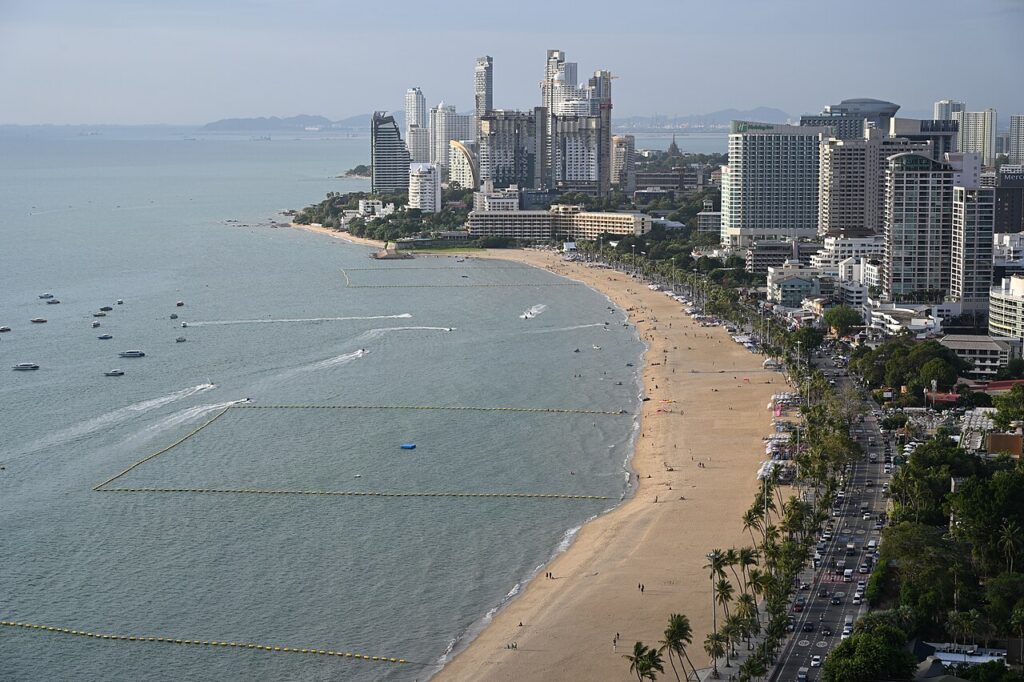
Land and houses
Foreigners can’t own land directly. Options such as long leases exist, but get proper legal advice.
Common questions
Can a foreigner own a condo in Pattaya? Yes, freehold in your own name, as long as the building’s foreign quota (49% of sellable area) isn’t full.
Do I need an FET form? You need proof the money came from abroad. Banks issue an FET form for transfers of US$50,000 or more, and usually a confirmation letter for less.
Do foreigners get the 0.01% transfer fee? No. The cut, extended to 30 June 2027, is for Thai nationals buying homes up to ฿7 million. Foreign buyers pay the normal 2%, usually shared with the seller.
Sources
Checked 13 November 2026: Forvis Mazars, 27 August 2026 (0.01% fees to 30 June 2027, Thai nationals only, ฿7 million cap); Lex Bangkok, property transfer fees (2%, specific business tax, stamp duty, withholding tax, foreigners pay the normal rate); The Thaiger, buying property as a foreigner, updated 26 August 2026 (49% quota, FET at US$50,000, juristic letters, land and building tax, nominee enforcement); Siam Legal, condo title deeds (Or Chor 2). This is general information, not legal advice. Rules change; use a qualified lawyer.
Useful next steps
- See buy or rent.
- See Thai tax basics.
Related guides


Related pages

Ride along with Jonny
Every guide page comes from the nightly rides through Pattaya. Watch them, ask questions in the community, or help keep the camera rolling.
Watch the rides Join the Telegram Leave a tip Support the rides

 ไทย
 中文
 Русский
 한국어
 Deutsch
 Français