

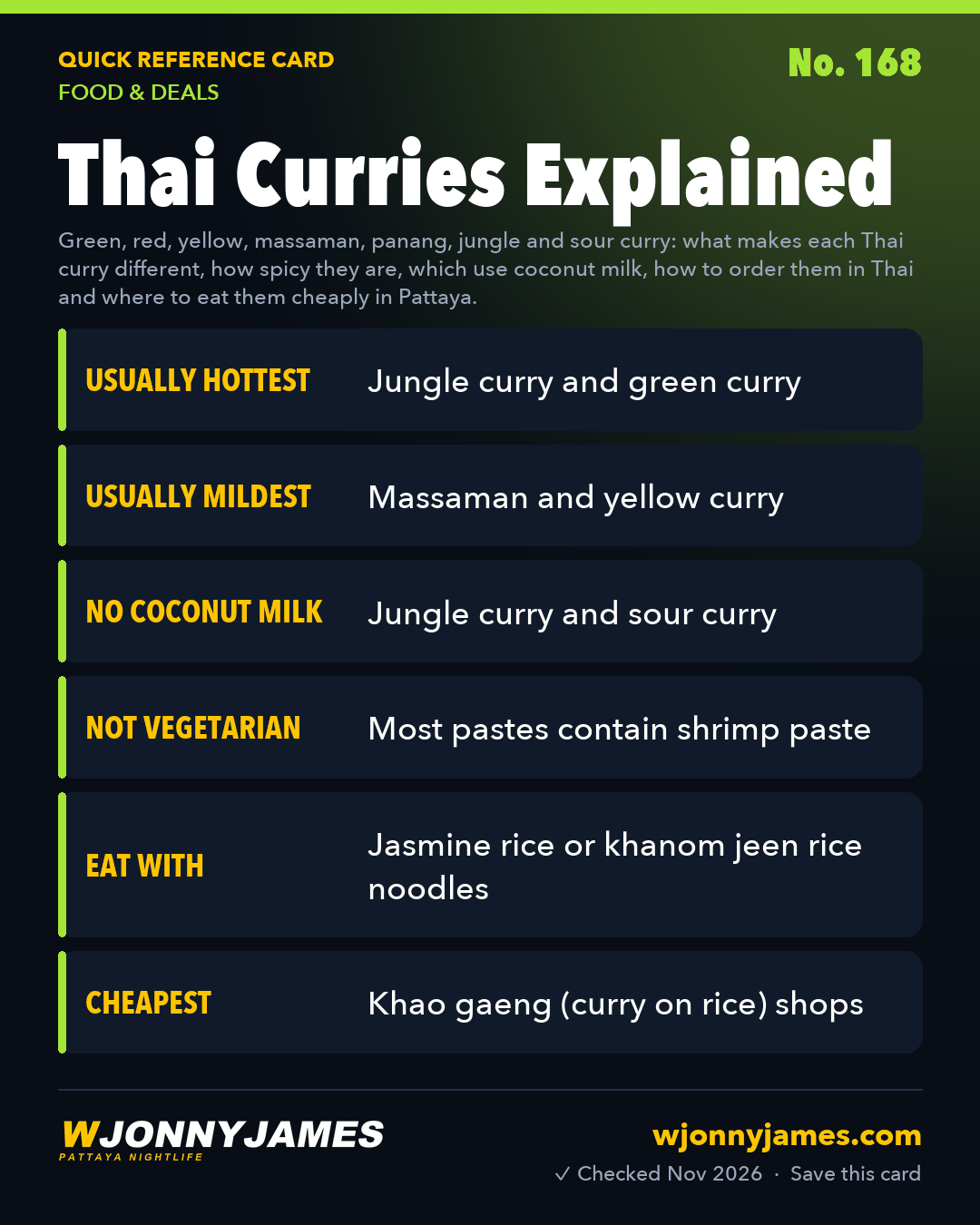
Quick answer: A Thai curry, gaeng (แกง), takes its character from its paste. Green uses fresh green chillies and is usually the hottest of the coconut curries; red uses dried red chillies; yellow is mild with turmeric; massaman is mild and warmly spiced with potatoes and peanuts; panang is thick and nutty; and jungle curry has no coconut milk and a lot of heat. Eat them with jasmine rice or soft rice noodles. The cheapest way to try several is a khao gaeng shop, where you point at pots and get two curries over rice. Most pastes contain shrimp paste, so ask before assuming a vegetable curry is food-deals/vegetarian-vegan/">vegetarian.
At a glance
| Curry | Thai | Coconut milk | Usual heat | What stands out |
|---|---|---|---|---|
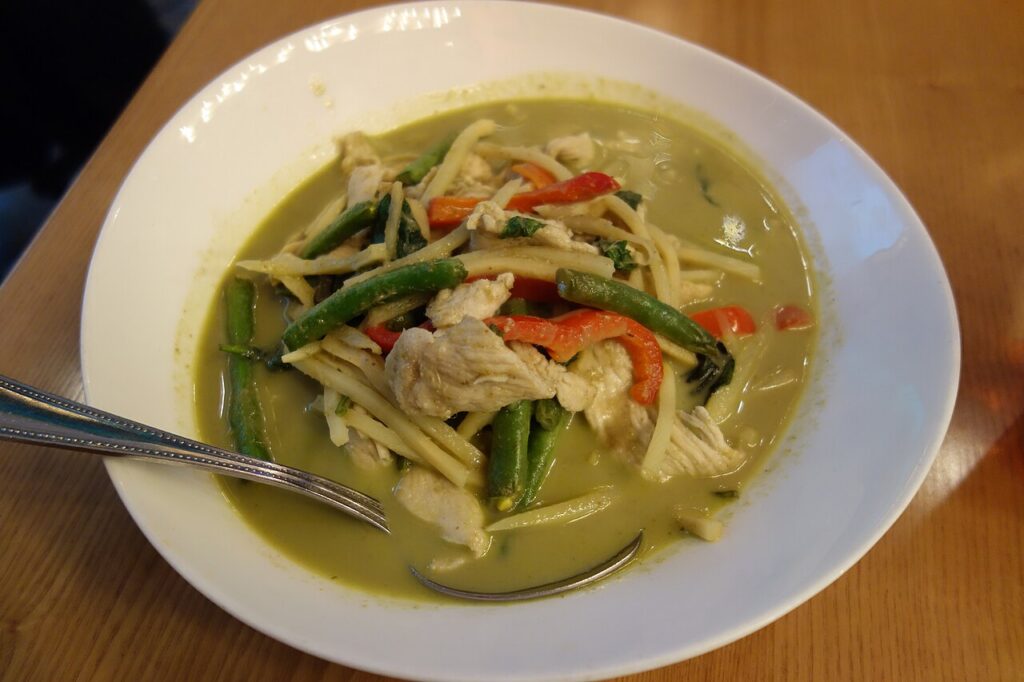
| Green | แกงเขียวหวาน | Yes | Hot | Fresh green chillies, Thai basil, pea aubergines |
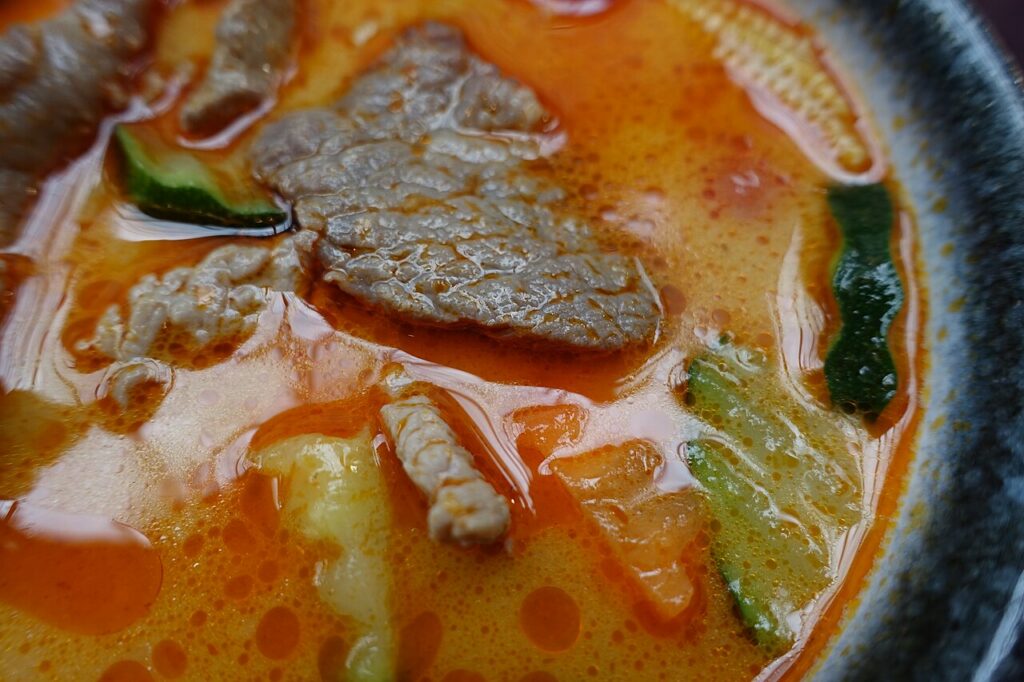
| Red | แกงเผ็ด | Yes | Hot | Dried red chillies, rich and fiery |
| Yellow | แกงกะหรี่ | Yes | Mild | Turmeric and cumin, potatoes, a little sweet |
| Massaman | แกงมัสมั่น | Yes | Mild | Cardamom, cinnamon and cumin, potatoes, peanuts |
| Panang | พะแนง | A little | Medium | Thick and nutty, lime leaves, little sauce |
| Jungle | แกงป่า | No | Very hot | Thin, herby, from the north |
| Sour | แกงส้ม | No | Medium to hot | Sour, broth like, often fish and vegetables |
Heat depends on the cook more than the name. A stall’s massaman can be hotter than a hotel’s green curry.
The main curries
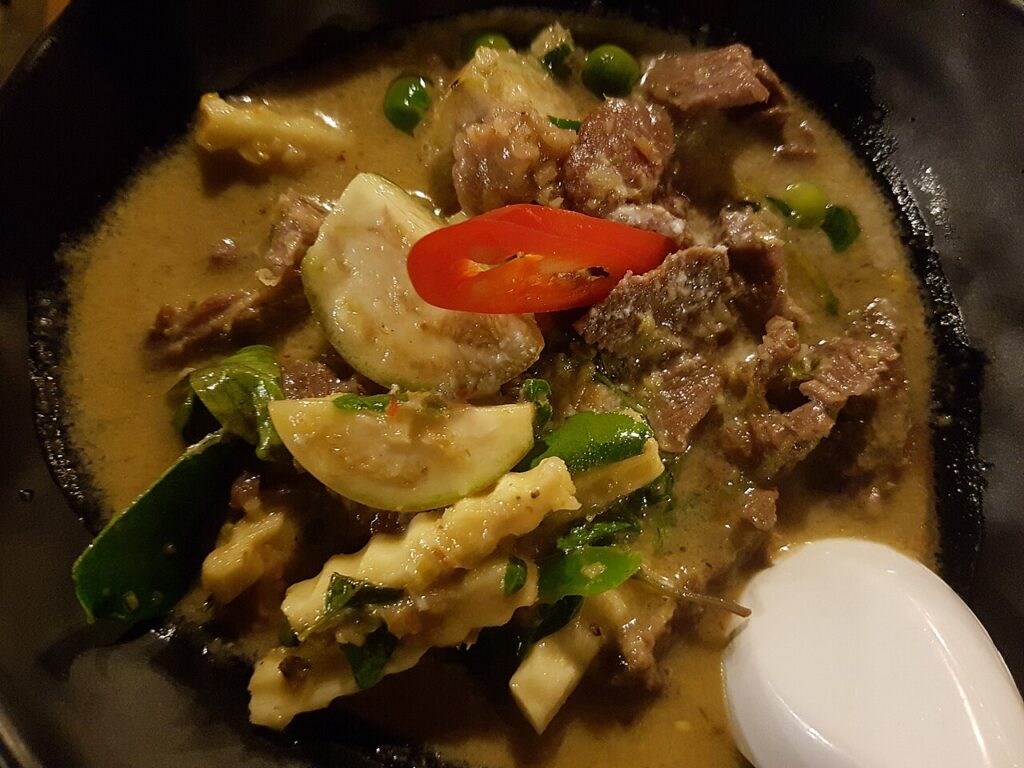
- Green curry (gaeng khiao wan): “sweet green” refers to the colour, from fresh green chillies. Coconut milk, Thai basil and lime leaves, often with chicken or fish balls. The Tourism Authority of Thailand names central Thailand as its home.
- Red curry (gaeng phet, “spicy curry”): made with soaked dried red chillies and coconut milk. Roast duck red curry with pineapple or grapes is a popular restaurant version.
- Yellow curry (gaeng karee): turmeric, cumin and other dry spices with coconut milk and cream, usually with chicken and potatoes. Mild and a little sweet, a good first curry.
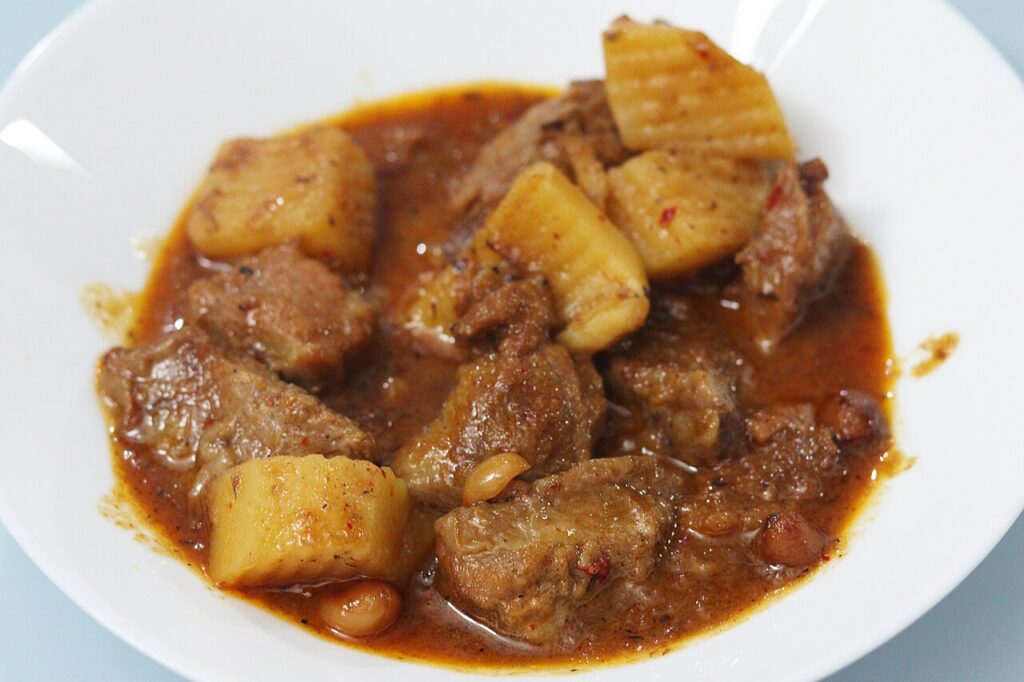
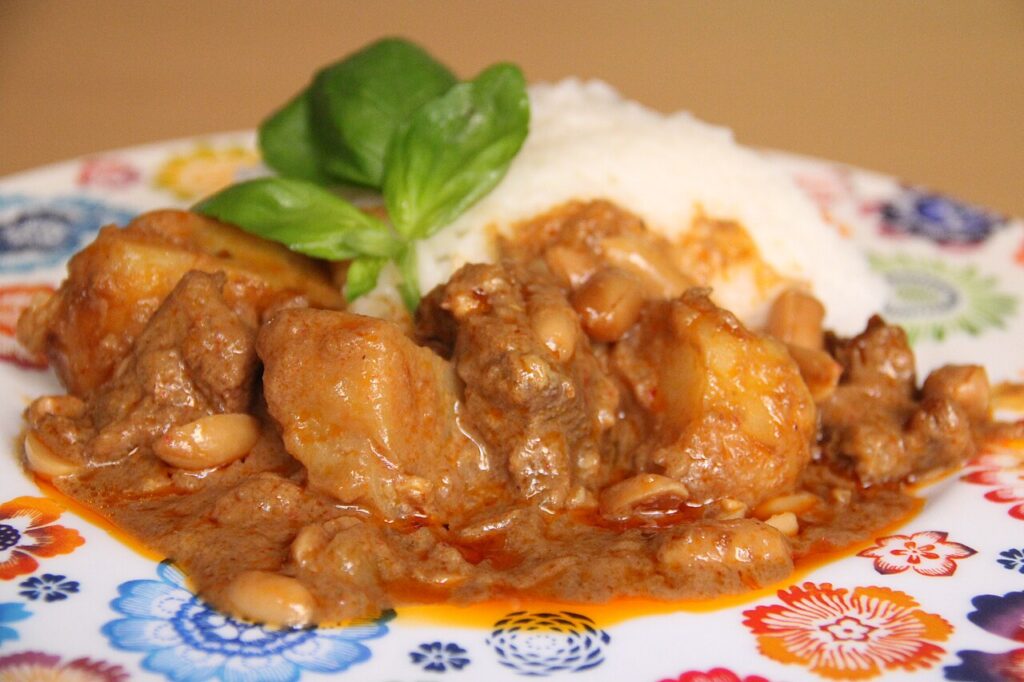
- Massaman (gaeng massaman): the name is thought to come from an old word for Muslim, and the dish is widely believed to have come to Thailand with traders from the Islamic world. A poem from the court of King Rama II praises it. Slow cooked beef or chicken with potatoes, onion and peanuts. Mild, with gentle heat softened by coconut milk.
- Panang (phanaeng): a thick, almost dry curry with little coconut milk, often beef or pork, with shredded lime leaves. Rich and nutty.
- Jungle curry (gaeng pa): from northern Thailand, made with stock instead of coconut milk, so it is thin, sharp and very spicy, packed with vegetables, green peppercorns and herbs.
- Sour curry (gaeng som): a thin, tangy curry soured with tamarind, often with fish or prawns and vegetables. Southern Thai versions are fierce.
Regional curries worth trying
- Khao soi (ข้าวซอย), from the north: egg noodles in coconut curry broth with crispy noodles on top. See noodle dishes.
- Southern curries: the TAT calls them the most powerful in Thailand. Look for khua kling, a dry fried minced meat curry, and gaeng tai pla, made with fermented fish innards.
- Isaan curries like gaeng om skip coconut milk too. See Isaan food.
How to order
- Pick the curry, then the meat: gai (chicken), moo (pork), neua (beef), kung (shrimp), pla (fish) or tao hoo (tofu).
- Set the heat: mai phet (not spicy) or phet nit noi (a little spicy). Curry paste already contains chilli, so “mai phet” means milder, not mild.
- Example: “gaeng khiao wan gai, phet nit noi khrap” is chicken green curry, a little spicy. Women end with kha.
- Over rice: add rad khao (ราดข้าว). Plain rice is khao suay (ข้าวสวย).
More phrases: ordering food in Thai and useful Thai phrases.
What to eat them with
- Jasmine rice is standard. Spoon a little curry onto the rice at a time, and eat with a spoon and fork.
- Khanom jeen (ขนมจีน): soft fermented rice noodles, very good with green curry, with fresh vegetables on the side.
- Roti with massaman is a common restaurant pairing.
- A fried egg (khai dao) on top of curry and rice is a cheap, popular extra.
Khao gaeng: curry on rice
Khao gaeng shops set out a row of pots and trays of ready made curries and stir fries. Point at one or two, and they’re ladled over a plate of rice. It’s fast, cheap and the best way to try curries you can’t name. Some vendors start at dawn, and the best dishes go by lunchtime. You’ll find them at markets, along busy roads and in food courts. See cheap eats, street food and food courts.
Vegetarian and allergies
- Most curry pastes, including green, massaman and panang, contain shrimp paste (kapi), and curries are seasoned with fish sauce. Ask for jay curry, made without both. See vegetarian and vegan food.
- Massaman and panang contain peanuts. For a serious allergy, show it written in Thai.
- Thai curries get their creaminess from coconut milk, not dairy.
Learn to cook them
Fresh curry paste is sold by weight at market stalls, and supermarkets stock ready made pastes and coconut milk. A cooking class is the quickest way to learn to make paste from scratch. See Thai cooking classes, fresh markets and cooking at home.
Common questions
Which Thai curry is the least spicy? Massaman and yellow curry are usually the mildest. Panang is in the middle.
Which Thai curry is the hottest? Jungle curry, then green and red curry, though it varies with the cook.
What’s the difference between red and green curry? Green curry paste uses fresh green chillies and herbs; red curry paste uses dried red chillies. Both use coconut milk.
Is massaman curry Thai? Yes. It has been cooked in Thailand for at least two centuries, but it’s widely believed to have Muslim trading roots, which shows in its warm dry spices.
Is Thai curry vegetarian? Usually not, because of shrimp paste and fish sauce. Jay shops make versions without them.
Sources
Checked 13 November 2026: Michelin Guide, what is massaman curry (January 2026); The Thaiger, Thai curries; Tourism Authority of Thailand, Thai cuisine of the four regions; SBS Food, Thai jungle curry; Michelin Guide, Thai noodles (khao soi and khanom jeen).
Spice guide
- Usually milder: massaman, yellow curry and panang.
- Usually hotter: green curry, red curry, jungle curry and southern curries.
Related pages
Ride along with Jonny
Every guide page comes from the nightly rides through Pattaya. Watch them, ask questions in the community, or help keep the camera rolling.
Watch the rides Join the Telegram Leave a tip Support the rides

 ไทย
 中文
 Русский
 한국어
 Deutsch
 Français