

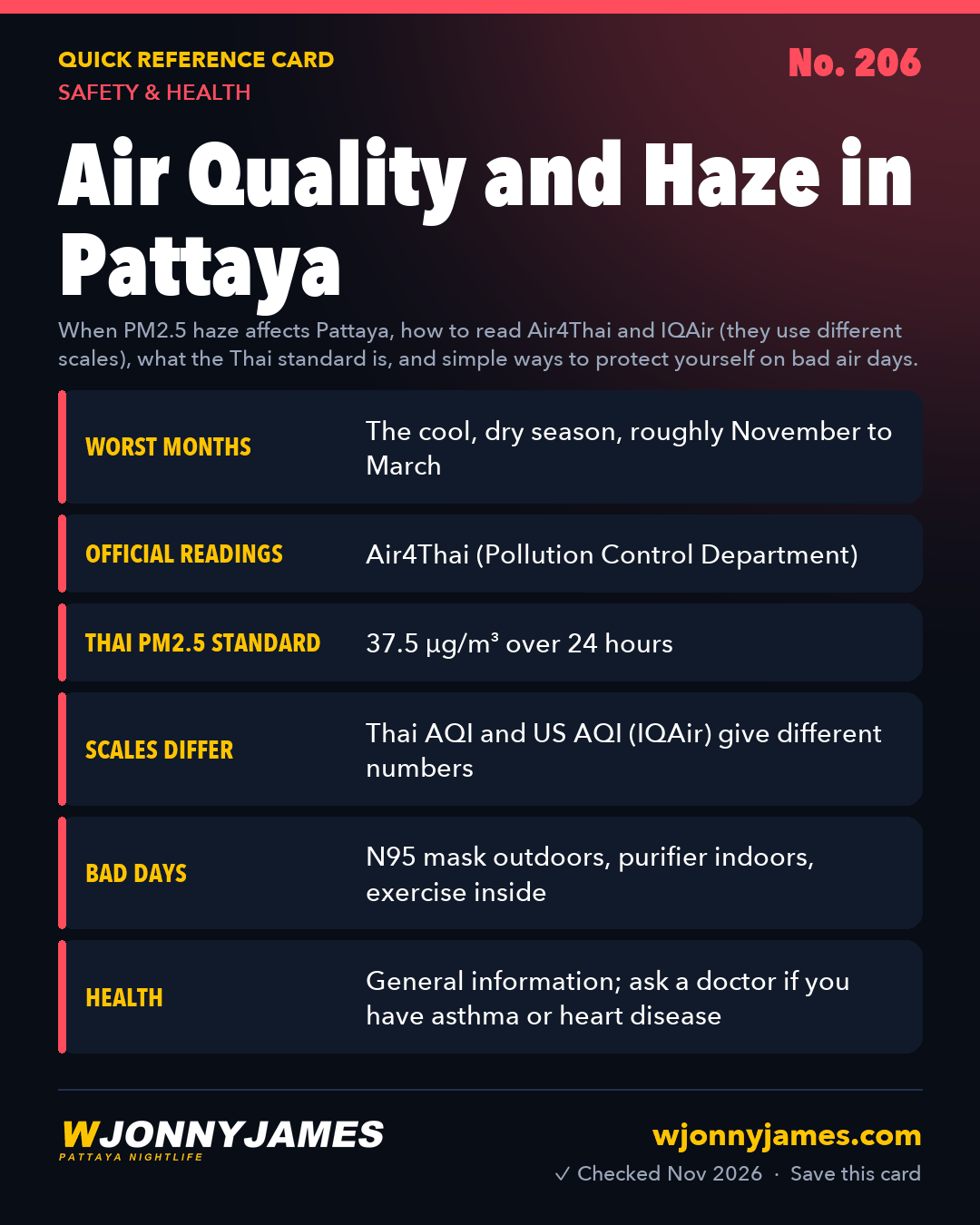
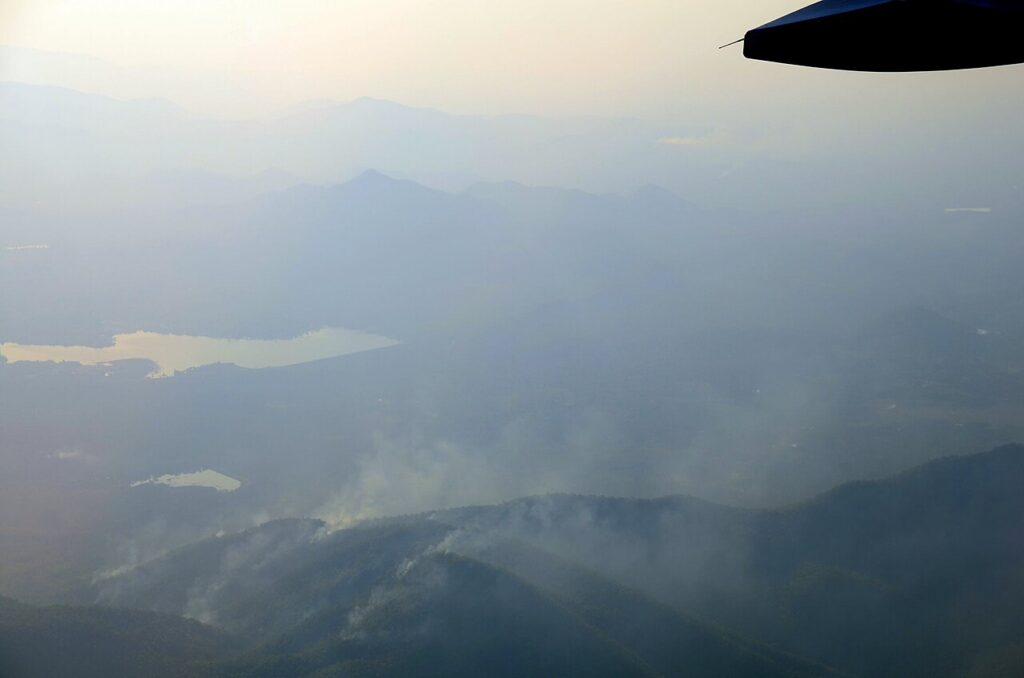
Quick answer: Pattaya’s air is usually fine, but fine dust (PM2.5) can build up in the cool, dry months, roughly November to March, especially on calm days. Local reports put the highest readings on busy roads such as Beach Road and Second Road. Check the official Air4Thai app or website from the Pollution Control Department, or IQAir. They use different scales, so don’t compare their index numbers: compare the PM2.5 figure in µg/m³. Thailand’s 24 hour standard is 37.5 µg/m³. On bad days, wear an N95 mask outdoors, run an air purifier indoors and move hard exercise inside. This is general information, not medical advice.
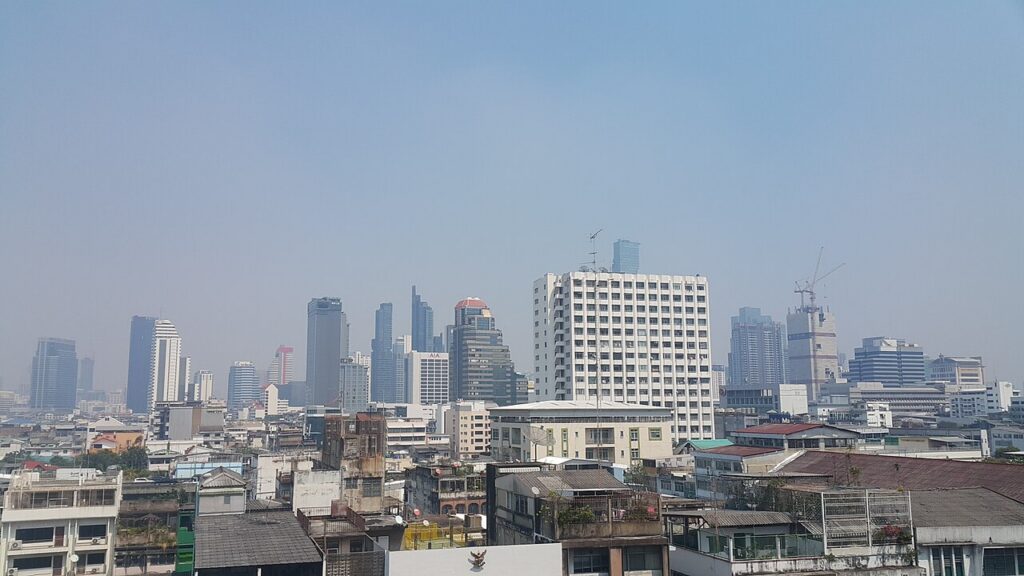
At a glance
| What to know | |
|---|---|
| Worst time | Cool, dry months, roughly November to March; rain and wind clear the air |
| Worst places | Busy roads; Beach Road and Second Road read highest in December 2025 reports |
| Main local causes | Traffic, construction and road dust, according to city officials |
| Official source | Air4Thai, from the Pollution Control Department |
| Popular app | IQAir, which shows the US AQI scale |
| Thai standard | PM2.5 37.5 µg/m³ averaged over 24 hours |
| Most at risk | Children, older people and anyone with an existing illness |
When and where it gets worse
- Season. In December 2025 The Pattaya News, using Air4Thai data, put central and north Pattaya at about 30 to 48 µg/m³, in the yellow to orange bands, and said the winter pollution season typically lasts until February or March.
- Spikes happen. In early November 2023 Pattaya briefly topped IQAir’s ranking of Thai cities, with a reading of 154, before rain was expected to bring relief.
- It isn’t always bad. On 3 January 2026 the national check found the East, including the Pattaya area, in the healthy range, while Bangkok and nearby provinces were over the standard, Pattaya Mail reported.
- Causes. Pattaya’s deputy mayor named construction, vehicle emissions and road dust as major contributors, and the city said it would wash and wet roads and enforce a ban on outdoor burning.
- Weather. Still air traps dust; rain and stronger wind usually clear it. See weather by month.
How to check the air
- Air4Thai (website and app) is the Pollution Control Department’s official system, with readings from government monitoring stations. Thai news reports and health warnings use its scale.
- IQAir (website and app) is widely used by visitors. It shows the US AQI, so its number for the same air is different from Air4Thai’s.
- Look at the PM2.5 figure in µg/m³ and the time it was measured. Some apps show hourly readings and others 24 hour averages, so a single hour can look worse than the daily figure.
- Check the station or sensor nearest to where you are. Readings next to a busy road are often higher than a few streets away.
Reading the numbers
Thailand’s scale has five colour bands: blue, green, yellow, orange and red. In June 2023 Thailand tightened its 24 hour PM2.5 standard from 50 to 37.5 µg/m³, and the red band now starts at 75.1 µg/m³.
| Thai AQI (Air4Thai) | Meaning |
|---|---|
| 0 to 25 | Very good |
| 26 to 50 | Good |
| 51 to 100 | Moderate |
| 101 to 200 | Starting to affect health |
| 201 and above | Affects health |
The US AQI used by IQAir runs on a different scale:
| US AQI (IQAir) | Meaning |
|---|---|
| 0 to 50 | Good |
| 51 to 100 | Moderate; unusually sensitive people may feel effects |
| 101 to 150 | Unhealthy for sensitive groups |
| 151 to 200 | Unhealthy |
| 201 to 300 | Very unhealthy |
| 301 and above | Hazardous |
For comparison, the World Health Organization’s guideline for 24 hour exposure is 15 µg/m³, stricter than the Thai standard.
Protecting yourself on bad days
The Public Health Ministry advice reported in December 2025 was simple:
- Wear an N95 or equivalent mask outdoors. Make sure it fits closely around your nose and chin.
- Limit hard exercise outside, especially in the morning and late afternoon.
- Use an air purifier indoors.
- Keep an eye on real time readings in Air4Thai.
- People with asthma, heart or lung conditions should keep their usual medicines with them and follow their doctor’s plan. If you have chest pain or trouble breathing, get medical help. See hospitals and clinics and pharmacies and medicines.
At home or in your room
- Keep windows closed when readings are high and run the air conditioning.
- A purifier with a HEPA filter helps most in the room where you sleep. Size it for the room.
- Clean or change air conditioner filters regularly. See home repairs.
Pro tip: I run an Electrolux UltimateHome 300 purifier at home and recommend it. It’s cheaper on Shopee than where I bought mine. Replacement filter: this one fits it. (I earn a small commission from Shopee if you buy through my links, at no extra cost to you. Affiliate disclosure.)
Planning around haze
- Exercise indoors on hazy days. See gyms and fitness and running and cycling.
- Choose indoor plans when readings are high. See indoor attractions.
- Visiting with children or older relatives in the cool season? Check the readings each morning and keep flexible plans. See best time to visit.
Common questions
Is air pollution bad in Pattaya? Usually not. Most of the year the air is in the good range, but fine dust can rise in the cool, dry months, and there are occasional bad spells, like November 2023.
Which app should I use, Air4Thai or IQAir? Either is fine if you understand the scale. Air4Thai is the official Thai source; IQAir shows the US AQI. Compare the PM2.5 figure in µg/m³, not the index numbers.
When is the air worst in Pattaya? Local reports point to the cool, dry season, roughly November to March, on calm days and near busy roads.
Do I need a mask in Pattaya? Only on bad air days. An N95 or equivalent, well fitted, is what health officials advise.
Sources
Checked 13 November 2026: The Pattaya News, Pattaya air pollution and Public Health Ministry advice (December 2025, Air4Thai data); The Pattaya News, city leaders on PM2.5 causes and measures (December 2023); The Pattaya News, Pattaya PM2.5 spike (November 2023); Pattaya Mail, PM2.5 mostly safe nationwide (January 2026); The Nation, new PM2.5 standard from June 2023; Chiang Rai Times, reading Thailand’s AQI (updated September 2026; not an official source); AirNow (US EPA), AQI basics; Air4Thai, Pollution Control Department; IQAir, Pattaya City. The months are a pattern from local reports, not a forecast. General information, not medical advice.
Related pages
Ride along with Jonny
Every guide page comes from the nightly rides through Pattaya. Watch them, ask questions in the community, or help keep the camera rolling.
Watch the rides Join the Telegram Leave a tip Support the rides

 ไทย
 中文
 Русский
 한국어
 Deutsch
 Français