

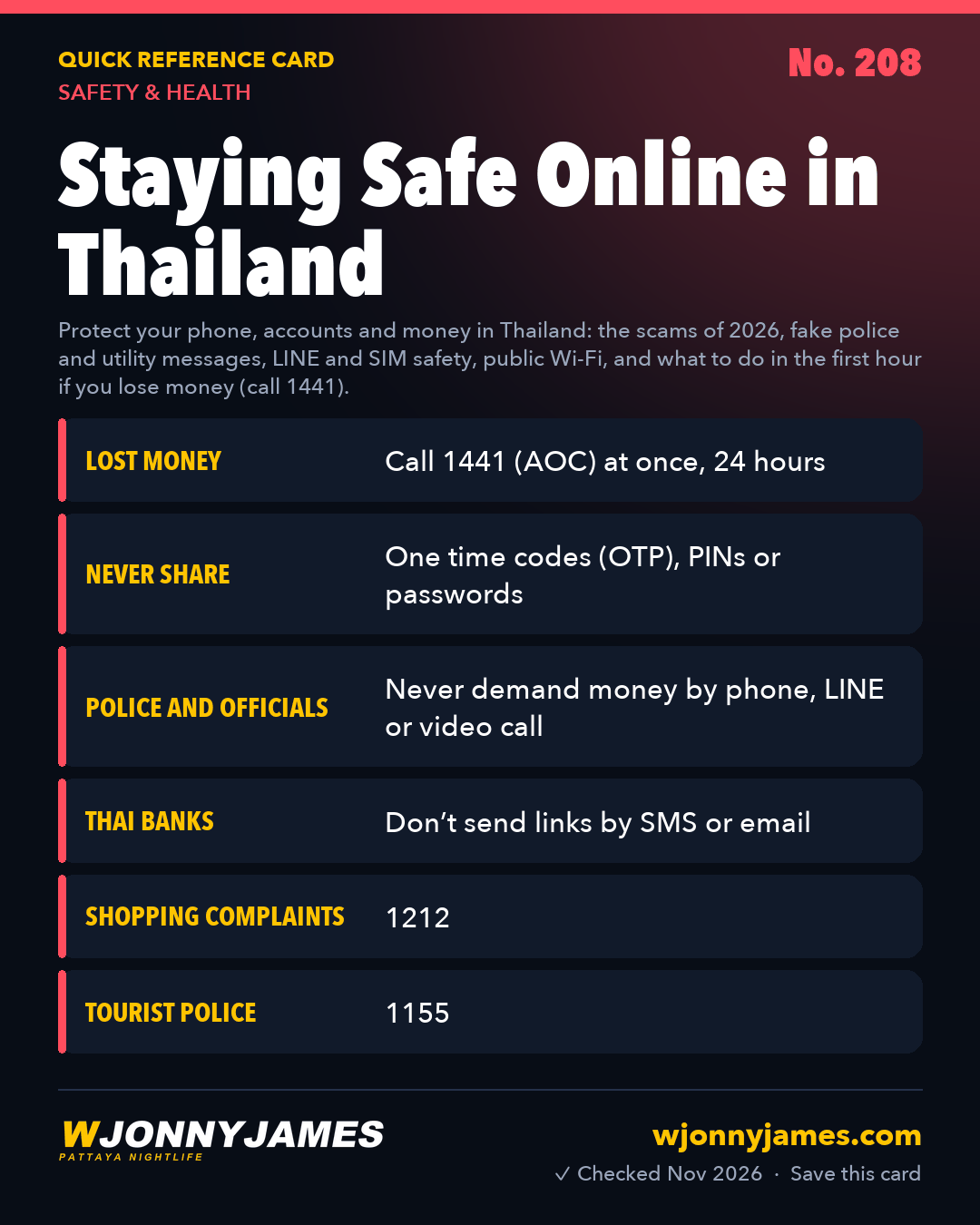
Quick answer: Online fraud is now Thailand’s biggest scam problem: the Thailand Consumers Council put losses at nearly ฿9 billion across more than 170,000 cases in the first half of 2026 alone. The scams that reach visitors and expats are fake police or bank calls, payment links in texts and LINE messages, fake shops and hotel pages, investment offers and online romance. Never share a one time code, never click a payment link you didn’t ask for, and hang up on anyone “official” who wants money. If money has already left your account, call the Anti Online Scam Operation Center on 1441 straight away so the receiving account can be frozen. Minutes matter.
At a glance
| Scam | How it starts | What to do |
|---|---|---|
| Fake police or officials | A call or LINE message saying you are linked to a crime or money laundering | Hang up. Officials don’t do this; call 1155 if worried |
| Fake bill or fine | A text or LINE message from a “utility” or agency with a payment link | Don’t click. Pay bills only in your own app or at the counter |
| AI voice or video | A friend or relative’s voice asking for an urgent transfer | Call them back on the number you already have |
| Fake shop or hotel | A cheap deal on Facebook or TikTok, pay by transfer first | Book on the official site or a known platform |
| Investment | Crypto or “digital stock” with high returns and small early payouts | Don’t invest through people you met online |
| Romance | A new online contact who soon needs money | See love scams |
The scams of 2026
Thailand’s Ministry of Digital Economy and Society named four trends for 2026: fake payment links by SMS or LINE posing as the electricity or water authority (the links can install data stealing apps), AI deepfake voices and videos, bogus crypto and “digital stock” investments, and fake profiles for romance, shops and hotels. Government agencies don’t send payment links by SMS or email.
In one week from 28 June to 4 July 2026, Thailand’s Anti Cyber Scam Center logged 5,588 online scam complaints with losses of about ฿208 million. Fake goods and services made up most complaints, but impersonating officials cost the most money.
Fake police, banks and couriers
These calls are built to frighten you into acting fast. Thai officials say real agencies:
- don’t phone to tell you about criminal charges,
- don’t send arrest warrants through LINE,
- don’t question people by video call,
- never ask you to transfer money to “check” or “protect” your assets.
Hang up, don’t add the caller on LINE, and call the official number yourself. The Tourist Police on 1155 speak English. See Tourist Police.
Your phone and SIM
- Use a screen lock and turn on two factor login for email, Apple or Google, and social media.
- Since August 2025 operators must use a live face check for new SIMs and for SIM swaps that keep the same number, and since 16 May 2026 new SIMs are registered in person. That makes SIM swap fraud harder, but if your phone suddenly loses signal for no reason, contact your network at once. See SIM cards and eSIMs.
- Only install apps from the App Store or Google Play, never from a link in a message.
- Back up photos and documents, including a copy of your passport. See phone repair and electronics.

LINE
Scammers use LINE too. Never share a LINE verification code, even with a friend whose account may have been taken over, and if a friend suddenly asks for money on LINE, call them first. Setup and safety settings are on the LINE app guide.
Banking and payments
- Never share a one time code (OTP), PIN or password, even with someone who says they are your bank.
- The Bank of Thailand told banks in 2023 to stop sending links in SMS and email. A text from “your bank” with a link is a red flag.
- Thai banking apps ask for a face scan for transfers over ฿50,000 at a time. If someone asks you to do a face scan “for verification” while on a call, stop. See mobile banking apps.
- Check the name that appears after you scan a QR code before you confirm. See QR payments.
Public Wi-Fi
Avoid logging into banking on open hotel, café or mall Wi-Fi. Thai mobile data is cheap, so use it for anything sensitive. For home internet, change the router’s default password. See home internet.
Shopping, bookings and second hand deals
- Book hotels and tours on the official website or a well known platform, not through a link someone sends you.
- Never send a deposit to a seller you haven’t met. See buying and selling second hand.
- For problems with online shopping that isn’t outright fraud, the 1441 centre points people to the consumer line 1212.
If you have lost money
- Call 1441 at once. It runs 24 hours and works with the police and banks to freeze the receiving account. If the line is busy, stay on: hanging up and calling again puts you at the back of the queue.
- Have ready: your ID, your bank and account number, the date and time of each transfer, the scammer’s bank and account numbers, a short timeline, and a phone number for the police text.
- Your report goes to the Thai Police Online system. You should get a text with a police case number within 24 hours, and you need to meet an investigator at the police station you chose within 7 days.
- Tell your own bank, and keep screenshots of chats, profiles and payment slips.
- Be wary of anyone online offering to “recover” your money for a fee. The 1441 centre says its service is only through the hotline, not social media.
See common scams for the scams that happen face to face.
Common questions
What is 1441 in Thailand? The Anti Online Scam Operation Center, run by the Ministry of Digital Economy and Society. Call it as soon as you realise you have sent money to a scammer, so the receiving account can be frozen.
Do Thai police contact people on LINE? Not to demand money. Officials say real agencies don’t send warrants through LINE, don’t question people by video call and never ask you to transfer money.
Can I report a scam online? Yes, through the Thai Police Online system at thaipoliceonline.go.th, or at a police station. Calling 1441 first is fastest when money has just left your account.
Sources
Checked 13 November 2026: Ministry of Digital Economy and Society, AOC 1441; The Nation, DE Ministry’s four scam trends for 2026 (26 December 2025); The Nation, weekly scam reports and official warnings (6 July 2026); The Nation, scam losses in the first half of 2026 (Thailand Consumers Council figures, 9 August 2026); Bank of Thailand, measures against online fraud (9 March 2023); Biometric Update, face checks for SIM registration and swaps (August 2025). Rules and numbers change; when in doubt, call 1441 or 1155.
Related pages




Ride along with Jonny
Every guide page comes from the nightly rides through Pattaya. Watch them, ask questions in the community, or help keep the camera rolling.
Watch the rides Join the Telegram Leave a tip Support the rides

 ไทย
 中文
 Русский
 한국어
 Deutsch
 Français