

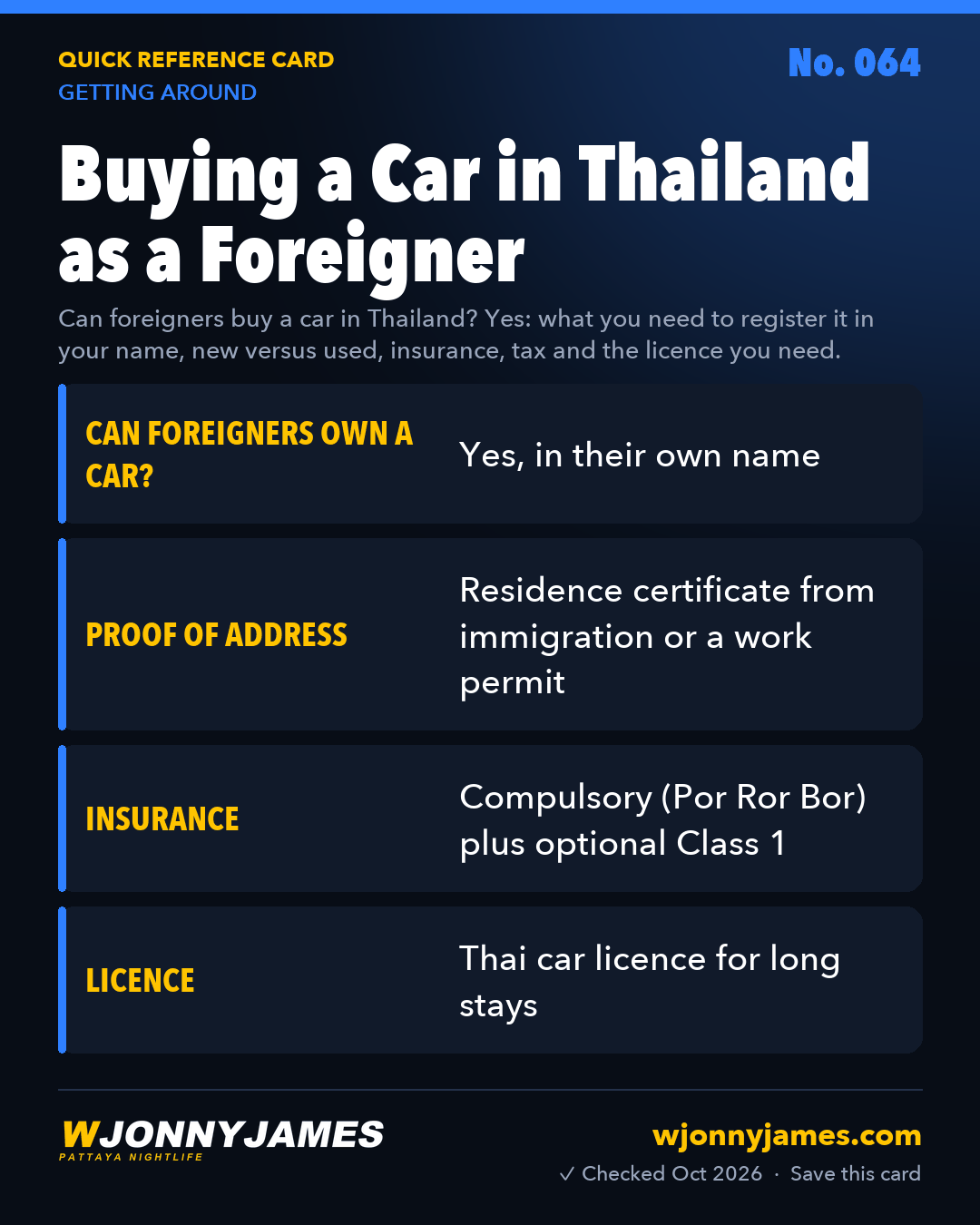
Quick answer: Yes, foreigners can buy a car in Thailand and register it in their own name. The extra step is proving your address, usually with a certificate of residence from immigration or your embassy, or a work permit. That is much easier on a long stay visa; on a tourist stay or visa exemption, many offices won’t register a car to you, so renting is usually the better choice for stays of up to about six months. A new car dealer handles the paperwork. A used car is transferred at the Department of Land Transport (DLT), with fees typically about ฿1,000 to ฿3,000. Each year you renew the compulsory insurance (about ฿645) and the road tax, and most owners add voluntary insurance. You also need a licence valid in Thailand; residents should get a Thai one.
At a glance
| Step | What to know |
|---|---|
| Who can register | Foreigners in their own name, with proof of a Thai address |
| Proof of address | Residence certificate (immigration or embassy) or a work permit |
| New car | The dealer registers it; you drive on a red plate for up to 30 days |
| Used car | Transfer at the DLT; both sides usually attend |
| Transfer fees | About ฿1,000 to ฿3,000 in total, mostly stamp duty |
| Finance | Usually needs a work permit and Thai income |
| Yearly | Por Ror Bor about ฿645, road tax by engine size, inspection if over 7 years |
What you need to register a car
- Your passport, with copies of the photo page and current visa.
- Proof of address. A certificate of residence from immigration is free and reported to take from one to 15 working days; bring your passport, your TM30 receipt, rental contract and a recent utility bill. See TM30 explained. Some embassies issue an address letter the same day for a fee. A work permit showing your address also works.
- For a used car: the seller’s ID, the registration book and signed transfer forms. For a new car: the dealer’s invoice.
- A valid Por Ror Bor certificate.
- Requirements vary, so ask at the Banglamung DLT before you pay a deposit.
New or used
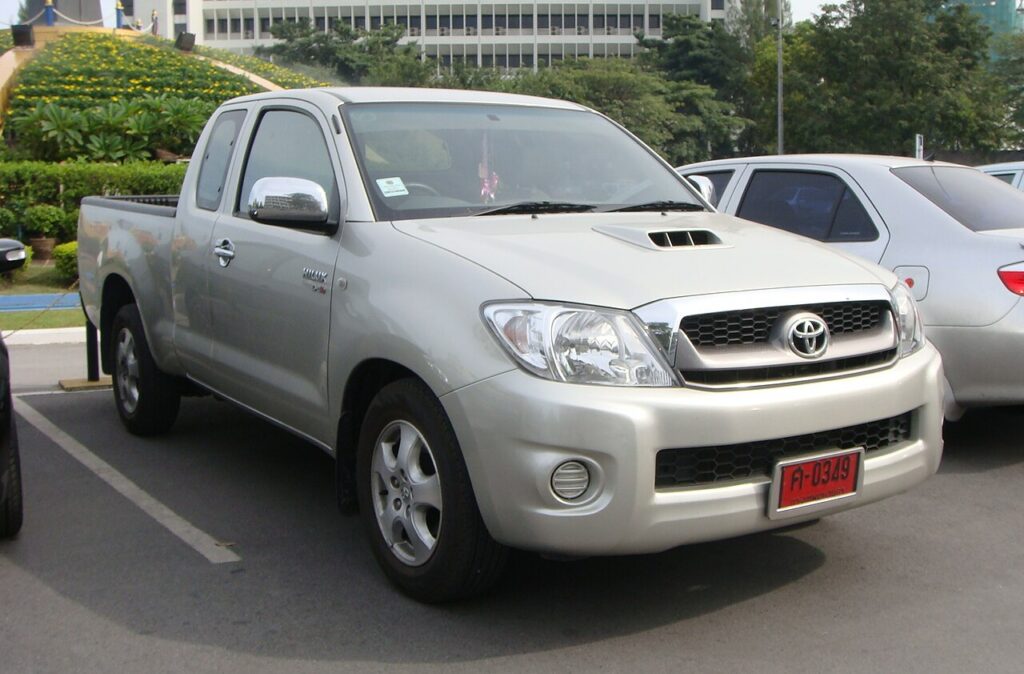
- New: the dealer registers the car and orders the plates. Meanwhile you drive on the dealer’s red plate, meant for no more than 30 days and limited to 6am to 8pm within the province unless trips are logged. Cash buyers can often negotiate off the first price.
- Used: cheaper, from dealers, private sellers and online. You check the car and papers yourself, and transfer ownership at the DLT.
What is a used car worth?
There is no Kelley Blue Book or NADA guide in Thailand that prices a car by its condition, mileage, options, service records and insurance claims, and the range of asking prices for the same car can be daunting. The best method I’ve found:
- Compare listings from all over the country, not just Pattaya: the same model, year, engine and trim on one2car and Facebook Marketplace.
- Message several sellers. Ask for the mileage, the service book and any accidents or insurance claims, and what they would really accept.
- Put it all together in a simple list. The middle of that range is a fair price; then adjust for mileage, condition and service history.
- For a reference price, check ttb bluebook, a free used car price guide from the ttb bank car loan arm. It is built from car magazines, dealer lots, auctions and car shows and reviewed every month. It prices by model and year, not condition, so treat it as a starting point.
- There is no national accident history report like the ones in the US, so the seller’s answers, the service stamps and a mechanic’s check matter even more.
Checking a used car
- The registration book (usually called the blue book for cars) must be in the seller’s name, and the engine and chassis numbers on the car must match it. Every past owner is listed; many owners in a short time is a warning sign.
- Finance: many cars are still owned by a finance company. The loan must be settled before the transfer. If the seller says the book comes after payment, pay the finance company directly against its release letter.
- Tax and fines: check when the road tax was last paid, and ask about unpaid tickets. Since August 2026, unpaid fines can hold up the tax sticker. See vehicle tax and plates.
- Condition: service stamps, tyres, air conditioning and a test drive. Odometer rollbacks are reported, so compare the mileage with the service history. Look for damp carpets, rust under the seats or a musty smell, which can mean flood damage. Paying a mechanic to look is money well spent.
- Facebook Marketplace and similar sites have good cars and scams. Never pay in full before the papers are right. See second hand buy and sell.
The transfer at the DLT
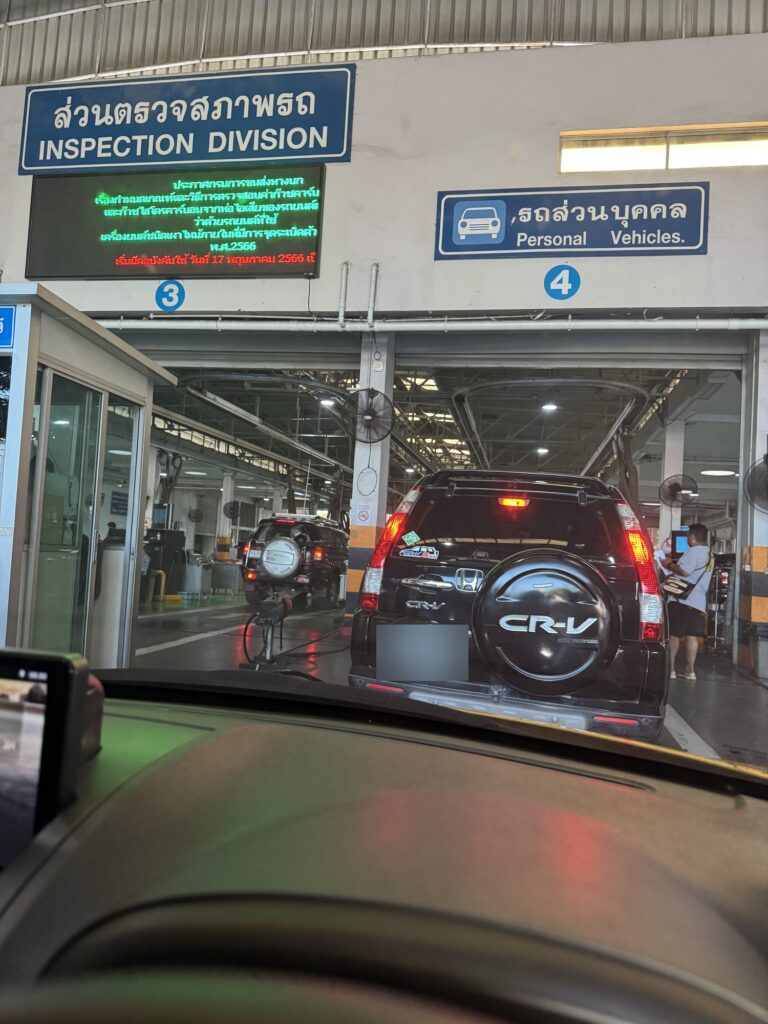
- Buyer and seller usually go together. The officer checks the engine and chassis numbers, you pay, and the book is updated with your name, often in one to three hours.
- Fees reported for 2026: about ฿100 for the transfer plus small form and inspection fees, and stamp duty that a legal guide puts at 0.5% of the DLT’s value for the car. A typical total is about ฿1,000 to ฿3,000. Cars over seven years old need an inspection first.
- By law, buyer and seller should notify the registrar within 15 days. A late notice can mean an administrative fine of up to ฿2,000.
- Avoid a “floating transfer”, where the seller signs the forms and leaves you to file later. Until the book shows your name, the seller is still the presumed owner, and insurers can push back on claims.
Insurance
- Por Ror Bor (compulsory): about ฿645 a year for a private car. It covers injuries to people, not damage to cars, and you need it to renew the road tax.
- Voluntary insurance: Class 1 covers your own car even when no other vehicle is involved, and costs roughly ฿4,300 to ฿20,000 a year depending on the car and the source. Class 2+ and 3+ pay for your car only after a crash with another vehicle; Class 3 covers only the other side.
- Insurers expect a licence valid in Thailand, and an invalid licence is a common reason claims are refused.
Road tax and running costs
- Road tax for a car up to seven seats is by engine size: about ฿1,200 a year for a 1,200cc car and ฿1,650 for 1,500cc, with discounts from the sixth year. See vehicle tax and plates.
- Budget for servicing, tyres, fuel, parking and tolls. Condo parking can be limited, so ask before you buy.
Pro tip: Something I’d add to any car here: a 12 to 24 V charger socket for road trips. It’s worked well for me. Mine came from Lazada; the link is the closest match on Shopee. (I earn a small commission from Shopee if you buy through my links, at no extra cost to you. Affiliate disclosure.)
Finance
Loans for foreigners are possible but hard: lenders commonly want a non-immigrant visa with 12 months or more left, a work permit, Thai tax returns and payslips, and often a Thai guarantor. Many foreigners buy outright.
Licence
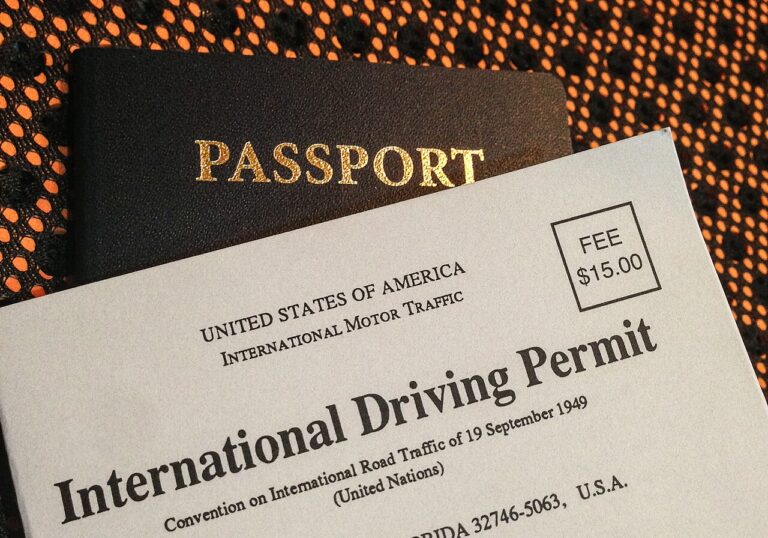
Long stay residents should get a Thai driving licence: it is what police and insurers expect, and it makes buying and insuring a car simpler. Visitors drive on an International Driving Permit with their home licence. See Thai driving licence and International Driving Permit.
Common questions
Can a tourist buy a car in Thailand? It is hard. Many DLT offices want an address linked to a nontourist stay. For short stays, renting is simpler.
What documents does a foreigner need to buy a car? A passport, proof of address (a certificate of residence or a work permit), the registration book and seller’s ID for a used car, and Por Ror Bor.
Is there a Kelley Blue Book for Thailand? Not one that covers condition and history. Compare listings for the same model nationwide, message several sellers, and use ttb bluebook as a reference price.
How much does it cost to transfer a used car? Usually about ฿1,000 to ฿3,000, mostly stamp duty, plus an inspection for cars over seven years old.
Sources
Checked 20 November 2026: Checkraka, ttb bluebook relaunch and Marketeer (17 November 2026) (what ttb bluebook is, its data sources and monthly review); a question in a Pattaya Facebook group and my own car searches, November 2026. Checked 13 November 2026: ThaiLawOnline, buying a car in Thailand (updated November 2026) (documents, certificate of residence, finance, fees, the 15 day notice and ฿2,000 fine, floating transfers; it notes it could not verify the 0.5% stamp duty rate itself); Motorist, used car ownership transfer (February 2026); The Thaiger, car insurance classes (updated September 2026); Chiang Rai Times, insurance costs (August 2026) (Por Ror Bor ฿645.21, Class 1 ฿12,000 to ฿20,000); Thairath, red plate rules (May 2026). Requirements differ between DLT offices. This is general information, not legal advice.
Related guides

Related pages

Ride along with Jonny
Every guide page comes from the nightly rides through Pattaya. Watch them, ask questions in the community, or help keep the camera rolling.
Watch the rides Join the Telegram Leave a tip Support the rides

 ไทย
 中文
 Русский
 한국어
 Deutsch
 Français